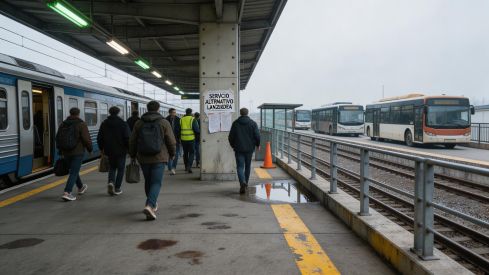
The works on the Garraf tunnel started this Monday, March 16 and have already altered the mobility of passengers on the southern Regionals and the R2 Sud, with a special impact on the station of Sant Vicenç de Calders, where throughout the morning transfers between trains and buses enabled up to El Prat de Llobregat have taken place.
On the first day of the alternative plan, several users have arrived earlier than usual to try to ensure their arrival in Barcelona. Renfe maintains that the first hours have developed with relative normality, although the consulted travelers describe incidents, lack of information, and longer journeys.
Renfe places the works between three and four months
Antonio Carmona, spokesperson for Renfe, explained that the works carried out by Adif between the Sitges and Garraf stations force a readjustment of the service in the southern corridor of Rodalies and Regionals. According to what he indicated, the disruptions will last between three and four months.
"The first hours of this alternative plan are developing in relative normality, the buses are operating within the more or less foreseen travel time"
"This action entails a restriction of operational capacity and a reprogramming of services on which ADIF, Renfe and the Generalitat de Catalunya have worked jointly" - Antonio Carmona, spokesperson for Renfe
The spokesperson added that the alternative by road is the best option for travelers who must travel to Barcelona.
Users who leave early and doubts with the information
Silverio, resident of El Vendrell and regular user, left three hours earlier to try to arrive on time to his job in Barcelona.
"I have to be at work at ten in the morning, I leave three hours early to be able to get there, I'm tired, every day is an adventure" - Silverio, affected user
Also Lucia Canal, a student from El Vendrell, opted for the bus due to the service changes and regretted the information received. She stated that the Renfe application does not work well and that she has had to get up earlier, with the expectation of returning home later.
"I don't know if the road will be a bit congested, I suppose so, I woke up earlier and I will get home later" - Lucia Canal, student
The student summarized the discomfort due to the accumulated situation in the railway network and due to the added difficulties since the start of the works.
Preference for the bus and complaints about transfers
Mar, a passenger from Torredembarra, came with more time to be able to park at the station and avoid being late for work. She explained that she chose the train because the schedules of the direct buses available from Altafulla and Torredembarra do not suit her.
"I'm going to El Prat, if I get there well, every ten or fifteen minutes a train should pass towards Passeig de Gràcia, leaving at seven from here, before nine in the morning I can be in Barcelona, which is what I hope for" - Mar, passenger from Torredembarra
Isaac, another affected user, reported waits and disorientation during the journey. According to what he related, he prefers the buses of the alternative plan because the journey with Rodalies takes too long.
"We have had to wait, they don't help us, we have come sitting on the floor of the train, they have dropped us off in the middle of Vilafranca and here nobody knows anything" - Isaac, affected user
The traveler assured that he does not want to arrive late to work and estimated the train journey at between an hour and a half and an hour and forty-five minutes to his destination.
The Generalitat sees room for improvement and the user platform charges against the plan
Susi López, director general of Transports and Mobility of the Generalitat, made a positive assessment of the first hours of the Alternative Transport Plan, although she admitted that the first day leaves room to correct aspects of the arrangement.
"The first day there is always a lot of room for improvement and, therefore, we will be seeing what those aspects are, all those things that can be improved we will surely try to improve them in the coming days and if it can be today itself" - Susi López, general director of Transports and Mobility of the Generalitat
The official stressed the strengthening of road transport, but recommended using the railway service due to its greater capacity.
Faced with this assessment, the Dignitat a les Vies platform harshly criticized the plan. Its spokesperson, Anna Gómez, maintained that it is a plan made without taking into account the real traveler, with impossible transfer schedules, lack of information, and errors in the indications within the stations.
"Today we are in the process of adapting it to the user, it's a step we should skip because it should have already been prepared" - Anna Gómez, spokesperson for Dignitat a les Vies
Gómez reported public address system problems and incidents in passenger orientation. He also warned of the risk of saturation at stations like Vilanova and Sitges. According to his complaint, the R2 Sud platform was completely full and there are also trains with accumulated delays.