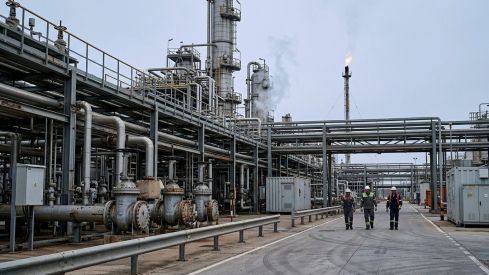
The production of Basic Chemistry fell by 3.7% in 2025 in Spain, a setback that directly hits a segment with strong weight in Tarragona's petrochemical hub and that already accumulates a 12.9% decrease since 2019. The sector's employers' association places energy costs as the main factor for this loss of activity and warns of the risk of divestment if urgent measures are not adopted.
Basic Chemistry concentrates 33.7% of all production in the Spanish chemical sector. Despite the more stable behavior of other branches, the 2025 balance again reflects the weakness of this industrial block, very exposed to energy prices and the evolution of external demand.
"In general terms, stable growth was maintained in the Consumer Chemistry and Pharma Chemistry sectors, Basic Chemistry again showed the weakness of international demand, fundamentally European, in key sectors such as automotive or construction" - report from the chemical employers' association
The energy again marks the setback
50% of the companies consulted attribute the fall in production to energy costs. Another 20% links it to the drop in demand. Regulation and installed overcapacity appear afterwards, with 10% of responses in each case.
The employers' association maintains that the loss of competitiveness remains very linked to the price of gas and electricity in Europe. In the case of gas, it indicates that the United States maintains prices between four and five times lower than those of the European reference market TTF, while China accesses this energy with average prices 30% lower than European ones.
In electricity, the difference is also notable. The United States and China record average final prices for industry of between 80 and 110 euros per MWh, compared to 179 euros per MWh of industrial average in the EU in the first half of 2025. Within the community market, the range was from 73 euros per MWh in Finland to 240 euros per MWh in Italy.
"Characterized by its high energy demand, Basic Chemistry continues to drag a serious competitiveness problem due to the disproportionate prices of gas and electricity that Europe has faced in recent years, particularly since the Ukraine crisis" - report from the chemical employers' association
External pressure and closures in Europe
The business organization adds other pressure factors on the European industry. Among them, it cites global installed overcapacity, especially in China, unfair trade practices in the form of dumping and subsidies, as well as the regulatory pressure differential linked to climate policies.
Since 2022, the European basic chemical industry has closed 126 plants and has lost 37 million tons of production capacity, a figure equivalent to 9% of the installed capacity. In this context, the European Commission has declared this segment strategic with the launch of the Critical Chemicals Alliance.
"All of this configures an especially adverse context for European basic and strategic industries, which demands the urgent activation of measures at community and national scale" - report from the chemical employers' association
Demand for urgent measures
The employers' association considers that Spain has partially cushioned this deterioration compared to other community countries due to the expectation of more competitive energy prices, supported by the renewable generation base and the better performance of the economy. Even so, it warns that the trend will continue downwards if shock measures are not applied.
Among the demands raised are structural reforms on electricity and gas. In the first case, it demands action on taxation, access tolls, adjustment services, and compensation for indirect CO2 emissions. In the second, it asks to develop the Statute of Gas-intensive Consumers to lower the final price of energy.
It also proposes to simplify the regulation that affects the chemical industry, accelerate and strengthen trade defense measures, and develop carbon contract for difference models to favor investments linked to climate neutrality.
The sector as a whole holds up by exports
In parallel to the fall of Basic Chemistry, the Spanish chemical sector as a whole closed 2025 with a turnover of 85,417 million euros, 0.1% less than the previous year. Total production grew by 1.3%, but the 1.6% drop in prices ended up nullifying that advance and reduced the business figure.
Exports reached 62,926 million euros, 6.4% more, which consolidated the chemical sector as the leading exporting sector of Spanish industry, with 18% of goods sold in foreign markets. Behind were the automotive sector, with 16.1%, and the food industry, with 15.2%.
The chemical industry obtains 73.7% of its turnover in international markets. 56% of exports were destined for European Union countries. The main community markets were France with 9.6%, Germany with 8.9% and the Netherlands with 7.1%. Outside the EU, the United States stood out with 4.9%, Switzerland with 3.6% and China with 3.3%.
Imports grew by 7.7% in 2025, up to 66,852 million euros. The main countries of origin were the United States with 12.7%, Germany with 12.6% and France with 10%, while China occupied the sixth position with 5.9%. With this scenario, the sector's focus remains on Basic Chemistry, a key activity in industrial enclaves such as Tarragona and increasingly conditioned by the cost of producing in Europe.