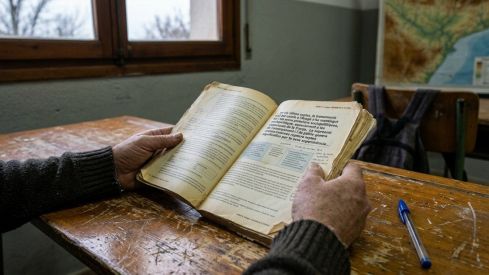
Vox has placed Catalan in La Franja at the center of negotiations to form a government in Aragon after winning six more seats in the last elections and reaching 14. Among its proposals is the abolition of the Institut Aragonès del Català and the elimination of mandatory teaching of this language in schools, a measure that would affect an area where more than 90% of students take two hours per week.
The paradox is that Catalan has hardly any effective protection in Aragon, despite the fact that current regulations allowed for the creation of the Acadèmia Aragonesa de la Llengua and the Institut Aragonès del Català itself. The language is not official, and its legal recognition already suffered a setback between 2013 and 2016, when it lost its designation and was renamed under the acronym LAPAO.
More than 90% of students take two hours of Catalan in voluntary education
The reform of Law 3/2013, promoted by the PSOE and the Chunta Aragonesista, granted Catalan generic protection as a cultural asset and opened the door to its school teaching. José Ramón Noguero, a member of the Moviment Franjolí, recalls that the current option involves teaching two hours per week, and that some schools have bilingual status to teach some core subjects in their own language.
"There is the option to teach two hours of Catalan per week, and some schools have bilingual status that allows them to teach some other core subject in their own language" - José Ramón Noguero, member of the Moviment Franjolí
In the area, Catalan teaching maintains broad local consensus, and its voluntary nature is predominant. The Moviment Franjolí maintains that withdrawing these hours would provoke opposition from PP mayors in La Franja, precisely in a territory where this school offering has massive implementation.
The political debate does not stem from a situation of administrative normality. Francesc Serés, a writer, argues that protection exists only on paper and that its scope is so limited that in most cases it is impossible to receive administrative attention in Catalan.
La Franja suffers from territorial disconnection that hinders organized response
Demographic and cultural consumption problems are added to the political risk. Serés links the decline of the language to the aging of the population, demographic changes, and the weight of audiovisual content in Castilian Spanish, although he recalls that the arrival of TV3, the weather map, and Catalan classes marked the linguistic awareness of La Franja.
The configuration of the territory itself also weighs heavily. La Franja extends in a long and narrow shape between Ribagorça, La Llitera, Baix Cinca, and Matarranya, with poor internal connections and different reference cities, a factor that complicates the organization of common events and linguistic activism.
"La Franja is a long and narrow territory that has, in some stretches, two villages in width and different reference cities" - Francesc Serés, writer
Noguero describes a historical disconnection between the north and the south and proposes a new phase for the movement. For the moment, the organization has concentrated its activity on social networks and has launched El Pregó de la Franja to follow current events and cultural initiatives in the four counties, while preparing events in the villages.
Disputes over the name and scope of Catalan remain open in areas such as northern La Llitera, which some Aragonese entities consider a transition territory between Aragonese and Catalan. Noguero interprets this discussion as an attempt to deny that the same language is spoken in Tamarit as in Alfarràs to reinforce a differentiated identity.
Serés foresees a difficult political stage and maintains that no force is committed to Catalan in Aragon. In this context, he added that the wear and tear for those who defend it is very high due to the level of disdain and incomprehension that, in his opinion, they continuously endure.