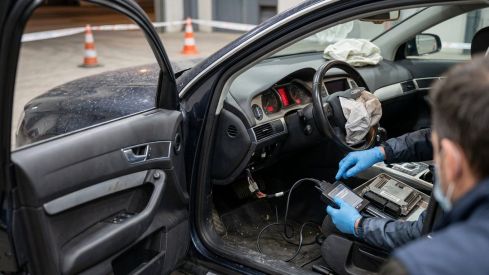
The technology installed in modern vehicles has transformed the way authorities reconstruct the most serious traffic accidents. The Mossos d'Esquadra have resorted to these tools in more than a thousand investigations since 2014 to clarify the exact circumstances of collisions.
An exponential increase in extractions
The pace of work has intensified notably during the last period. Currently, agents carry out between 150 and 200 data extractions annually, a figure that shows sustained growth especially from 2024 onwards.
These electronic devices capture critical information in the final moments before impact.
"They record the five seconds prior to a collision just before the airbags deploy" - Francesc Parra, head of the Road Research Division
The system's memory stores vital parameters such as instantaneous speed, simultaneous use of the brake and accelerator, or sudden steering wheel movements. It also verifies if the safety systems were operational at the time of the accident.
Surgical precision on the scene
This technical capability allows researchers to obtain a faithful X-ray of what happened. The police use this technology in 30% of serious or fatal accidents due to its high reliability in determining responsibilities.
Although it does not constitute definitive expert evidence on its own, it can be decisive in detecting speeding or reckless imprudence behind the wheel.
Objective records have dismantled contradictory versions on multiple occasions. In a case recorded on the C-32 highway, the black box showed that a driver was traveling at 151 km/h in a section with a limit of 80 km/h.
Technical limitations and privacy
The data does not always confirm the main driver's guilt. In another incident, technology initially allowed to rule out speeding and highlight an unexpected maneuver by another vehicle that invaded the oncoming lane.
The police official emphasizes that these devices do not record personal data, as European regulations expressly prohibit it to protect user privacy.
Insurance companies can also access this information within the framework of their own private investigations into civil liability.
The heterogeneity among different manufacturers complicates both the extraction and the correct interpretation of digital files. Each brand uses different protocols that demand very specific technical knowledge.
The Public Security Institute of Catalonia works on specific training for agents with the aim of adapting to the new technological challenges posed by connected vehicles.