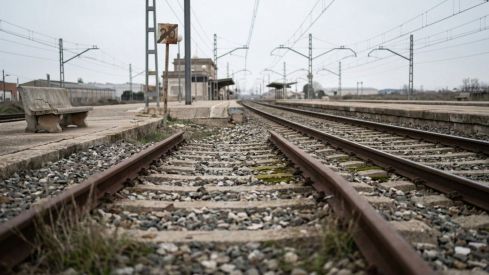
Infraestructures de la Generalitat has put out to tender the drafting of the preliminary study to improve intermodality between train and bus in the vicinity of l'Aldea-Amposta station, with a budget of 136,000 euros. The commission opens the door to reorganizing the accesses and connections of a hub that for years has demanded greater importance in the mobility of Terres de l'Ebre.
The contradiction has been on the table for a decade. The station that the Trens Dignes platform claims as the main railway gateway to the territory still lacks a direct connection to the N-340, the AP-7, and the C-42, a deficiency that has prevented the consolidation of a true interchange between train and bus there.
The Generalitat commissions the study of the train-bus connection for 136,000 euros
The study will have to specify how to improve intermodality in the vicinity of the station and what services could be organized from that point. Joan Castor Gonell, delegate of the Government in Ebre, explained that the document will serve to define the needs and uses of users and to check if buses can be connected from the station to different towns.
The demand is not new. For ten years, Trens Dignes has argued that l'Aldea-Amposta station must play a central role in Terres de l'Ebre and has also requested a bus station next to the railway complex.
This request clashes with the current configuration of accesses. The lack of a direct link to the main roads in the area has so far limited the station's function as an interchange point for travelers from different municipalities.
HIFE improves the highway stop while the central hub remains pending
In parallel, HIFE is working on improving the bus stop and interchange located at the highway exit roundabout. At this point, transfers to Barcelona and Tarragona are made, which keeps a portion of the current traveler flow away from the train station.
The coexistence of both spaces summarizes the debate open in the area. On the one hand, the private company reinforces an already operational interchange, and on the other, the Generalitat studies how to bring the bus closer to the station to organize the connections for the entire territory.
The Catalunya Sud industrial estate plans a freight terminal with a railway branch
The action on travelers coincides with another broader planning in the same area. The Generalitat continues to work on the Master Plan to expand the Catalunya Sud industrial estate, whose initial approval is planned for this year.
That growth will incorporate an intermodal freight station with a railway branch to facilitate the transport of companies such as Kronospan. The forecast reinforces the logistical role of the l'Aldea area while the passenger connection is still in the study phase.
Gonell framed both actions within a change of model and maintained that, in the future, road transport will become increasingly difficult. The expansion of the Catalunya Sud industrial estate foresees an intermodal freight station with a railway branch to serve companies such as Kronospan.