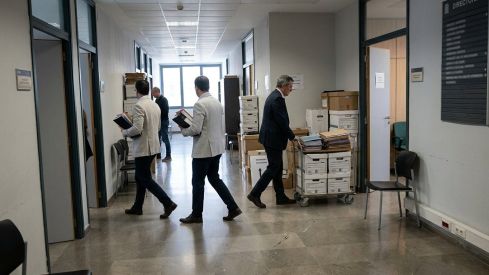
The reorganization of Justice in Tarragona after the entry into force of Organic Law 1/2025 has caused a 30% drop in productivity and has forced the relocation of offices and bureaus in almost all eight judicial headquarters of the city. The new model culminated on December 31 in the judicial districts of Tarragona, Reus, and Tortosa, with the disappearance of the single-judge courts and their replacement by the Courts of First Instance.
The president of the Provincial Court of Tarragona, Joan Perarnau, admits that the implementation phase is generating incidents both organizational and technical. The changes in personnel location, especially among civil servants, are already almost finished, but during these months they have affected the ordinary pace of work and have even caused the suspension of trials.
"We are in a period of transformation. What there is today are headaches" - Joan Perarnau, president of the Provincial Court of Tarragona
Technical problems and delays in judicial activity
Perarnau attributes part of the difficulties to computer failures, database access problems and telephone breakdowns. To that is added the impact of the new organizational system, which jointly centralizes tasks such as citations or the execution of sentences through common notification and execution services.
The combination of technical incidents and internal adjustments has altered the daily functioning of Tarragona's judicial bodies. In practice, the new structure has not yet achieved a stable dynamic, and the forecast is that normalization will not be immediate.
"We have to give ourselves a margin of between six months and a year. Before that is difficult" - Joan Perarnau, president of the Provincial Court of Tarragona
The president of the Court adds, however, that the consolidation of the change should be materialized in June, with normalized conditions, although the complete adjustment of the system will require more time.
Pressure in the penal sections
The situation also affects the workload in the Provincial Court. In Section Two there are 19 trials with popular jury scheduled throughout this year. Each of them lasts approximately two weeks, about 15 days in which a magistrate cannot attend other oral hearings.
With the current staff, there is no margin to absorb all the new cases that are entering the two criminal sections. That pressure translates into delays and in the usual application of mitigating circumstances due to procedural delay.
"We systematically apply undue delays" - Joan Perarnau, president of the Provincial Court of Tarragona
The legal profession detects distortions and a certain collapse
The dean of the Illustrious Bar Association of Tarragona, David Rocamora, agrees that the entry into force of the new law has had an immediate impact on the functioning of the courts. In his opinion, the change has generated a particularly complex transitional scenario.
"It has originated serious distortions, which have generated a certain collapse" - David Rocamora, dean of the Il·lustre Col·legi de l"Advocacia de Tarragona
Rocamora considers, even so, that the result can be positive with the passage of time.
"Surely the balance will be better in the medium and long term. Now we are expectant" - David Rocamora, dean of the Illustrious Bar Association of Tarragona
The dean also questions the part of the law that regulates alternative dispute resolution measures. Specifically, he maintains that they should not be required in family precautionary measures nor in eviction proceedings when there are repeated non-payments of rents.
The possible concentration of criminal jurisdiction in the Palau de Justícia
Beyond the deployment already executed, a new reorganization of venues in Tarragona is under study. The proposal involves moving the four Criminal Courts, located on Sant Antoni Maria Claret street, to the Palace of Justice. At the same time, the two civil sections that are now in the Palace of Justice would move to Sant Antoni Maria Claret.
The objective, in Perarnau's words, is to concentrate all criminal jurisdiction in a single building. The operation, however, encounters a main obstacle, the lack of space in the Palace of Justice. To make it viable, it would be necessary to enable four courtrooms, one for each court, in addition to new secure prisoner transport circuits.
The possible exchange of venues has the backing of the Tarragona legal profession. Rocamora considers it an adequate solution and defends that the concentration of oral trials in a single building would allow for more efficient management. For the moment, Justice in Tarragona continues operating in full transition, with movements almost finalized on the ground but with months ahead to recover stable activity.