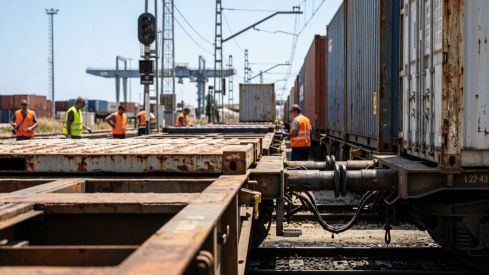
The entry into operation of the Mediterranean Corridor may push the coastal railway line between Tarragona and Sant Vicenç de Calders above its maximum capacity. A study commissioned by the platform Mercaderies per l'Interior and carried out by the consultancy Mcrit calculates that traffic would increase from the current 170 daily trains to 224.
The paradox highlighted by the report is that an infrastructure designed to strengthen rail freight transport may end up pushing cargo onto the asphalt. Engineer Efraín Larrea maintains that, with priority for passenger trains, freight trains "will not fit" on that section and part of that traffic will end up on trucks.
The section already uses 85% of its capacity and will add 54 more trains
Currently, 170 trains run on that line per day, 85% of the infrastructure's capacity, set at 200 daily trains. Of these, 27 are freight trains.
With the entry into service of the third track, planned from next year, this figure would rise to 31 freight trains. To this increase, another fifty passenger trains included in the programming of Rodalies Catalunya and the Generalitat de Catalunya would be added.
The result is an estimate of 224 trains per day between Tarragona and Sant Vicenç de Calders. The study was presented at the headquarters of Pimec Tarragona, where Larrea warned that the planned trains would exceed the maximum capacity of the track and added that the new scenario would further aggravate service delays.
"The freight trains will not fit us, because passengers have priority, which means that this traffic will go by truck" - Efraín Larrea, engineer
Eugeni Sedano, spokesperson for Mercaderies per l'Interior, argued during the presentation that the report provides a quantified basis for the debate on freight routes. The platform has long maintained that the current coastal route cannot absorb the projected growth.
The European objective for 2030 would increase the impact to 1,560 trucks per day
The study also presents a scenario of greater pressure if the train reaches a market share of 10%, the objective set by Europe for 2030. In that case, more than 250 trains could run on the section.
That volume would have a direct effect on the AP-7 if the railway network does not absorb the demand. The report calculates that 1,560 trucks per day could be added to the AP-7, a figure that the platform uses to warn of the transfer of goods from the railway to the road.
Mercaderies per l'Interior proposes an inland route solution with an estimated investment of 440 million euros. This figure is below the almost 560 million euros of the proposal being considered by the Ministry of Transport.
According to the economic analysis presented in Tarragona, all the alternatives studied offer an internal rate of return greater than 97%. In one of the scenarios, this profitability approaches 150%, with a payback period for the construction of a segregated double platform for goods in five years.
The Generalitat tendered its own study due to the lack of a state alternative since 2023
While the technical debate continues, the Generalitat de Catalunya has put out to tender the drafting of a study on the railway in the Camp de Tarragona. The assignment must define a proposal for goods in the absence of an alternative from the Ministry of Transport since 2023.
José Enrique Vázquez, representative of Pimec Tarragona, linked this lack of definition with the growing pressure on the road and rail network. During the event, he warned that if another infrastructure does not start, the territory may end up with a problem similar to that of the AP-7.
Ignasi Sayol, president of the Logistics Sector of Pimec, also questioned the budgetary priority given by the Generalitat to the orbital line. Sayol estimated this action at around 5.2 billion euros and stated that public accounts are deciding on investments far from the productive economy.
Among the requests made at the presentation is the creation of a National Infrastructure Pact to set priorities among political representatives and institutions. The platform compares this demand with an alternative investment of 440 million euros for the inland route, compared to the almost 560 million euros of the Ministry of Transport's proposal.