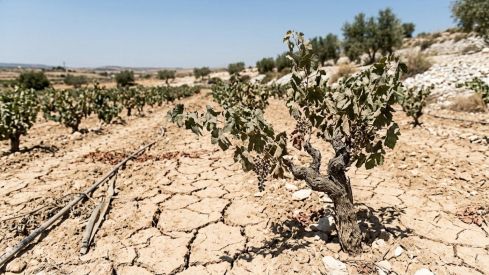
Climate change will expand in Catalonia the area where Mediterranean species such as almond, olive, or orange trees can be cultivated, but this expansion will come with a greater dependence on irrigation. The report Modeling the impacts of climate change on the potential cultivation area and water deficit in five Mediterranean crops, prepared by experts for the consultancy Pigall, foresees profound changes in agricultural production.
The paradox described by the study is clear. While stored reserves currently exceed 85% of capacity, the water needs of crops in Catalunya will increase by 16% between 2031 and 2050, more than double the previous estimate of 7%, and snow levels are already at drought thresholds after a record winter.
The almond tree will gain 19.4% of viable surface area and barley will depend on irrigation
The document maintains that the increase in temperatures and the reduction in precipitation will not cut the potential area of any of the analyzed crops. On the contrary, they will open the door to planting them in areas that were too cold until now, as long as water demands can be met.
"All crops will have more potential cultivation area, but will depend more on the availability of irrigation" - Report Modeling the impacts of climate change on the potential cultivation area and water deficit in five Mediterranean crops, Pigall consultancy
In that scenario, the almond tree will increase its viable surface area by 19.4%, the olive tree by 7.2%, and the orange tree by 12.2%. The study places almond cultivation projections in a large part of Noguera and Solsonès, olive cultivation in Alt Urgell and the Pallars, and orange cultivation in Les Garrigues.
The adaptation will not be the same in all cases. The almond tree will require late-blooming varieties and also hybrids for shorter seasons, while the olive tree will remain viable as dry farming in 41.8% of the territory, although the areas where irrigation will be mandatory will grow by 15.4%.
In extensive crops, the impact will be more restrictive. Barley may be cultivated in the entire demarcation except in the highest areas of Aran, Pallars Sobirà, and Alta Ribagorça, but it will not survive without irrigation on the plain and 45% of the land currently dedicated to this cereal will require irrigation.
Even more demanding will be the intensive cultivation of barley, which will require irrigation in 75% of the viable area. At the same time, dryland soils will lose productivity for alfalfa, with drops also in areas that already need water due to the small economic margin of the crop.
The plains and the Pyrenees face more heat and less rain between 2031 and 2050
The climate projections handled by the report point to an average increase of 1.9 degrees in summer and 1.7 in autumn on the plain. In the Pyrenees, the rise will be 1.9 degrees in summer, 1.8 in autumn, and 1.4 in winter.
If the series is extended to half a century, the increase is close to 3 degrees in summer and ranges between 1.8 and 2.1 degrees in winter. That record exceeds the 2-degree threshold set by the UN's IPCC for the period 1850-2100.
Precipitation will also fall. The predicted decrease ranges from 1.1% to 1.8% in winter and from 8.4% to 11.5% in the rest of the seasons, an evolution that will extend the subtropical thermal regime and make the semi-arid Mediterranean the most frequent humidity pattern.
That increase in temperatures already has a reflection in public health in the regions of Lleida. Between 2021 and 2025, 167 people died from heat, with an average of 33 deaths per year and a range of between 23 and 51, compared to the annual average of 25 registered between 2016 and 2020.
The report adds that rainfed cereals on the plain will see their viability compromised and that the implementation of forages, fruit trees, almond trees, and olive trees in medium mountain and Pyrenean areas will clash with the lack of irrigation infrastructure, despite the fact that stored reserves currently exceed 85% of capacity.