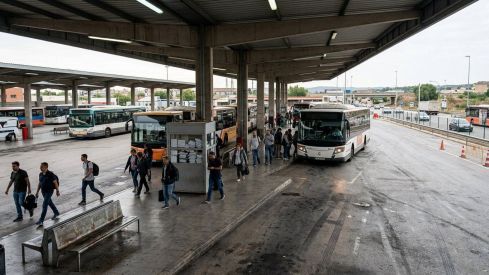
The Govern prepares a six-year extension of interurban bus concessions that remain in force in Cataluña and that, in principle, expire in 2028. The extension, which different sources place until 2034, fully affects the open debate in the Camp de Tarragona on the future metropolitan mobility model.
The measure would entail extending some contracts awarded in 2003, in the final stretch of the Govern of Jordi Pujol. The move contrasts with the line that had been defended until now by the Secretary of Mobility, Manel Nadal, who had expressed the will of the autonomous administration to put out to tender all existing lines to update and renew them.
The railway context changes the scenario
The shift in approach occurs at a time marked by railway incidents and by the planned works in the Rodalies network in the coming years. In this context, the interurban bus gains importance as a support network. It is highlighted, in fact, that this transport has been the one that has offered greater safety to Tarragona users during the Roda cut of 2025 and now with the affectation in the Garraf tunnels.
Among the arguments put on the table is the risk that a public tender leaves routes without an operator or causes the most relevant routes to pass into the hands of foreign companies. Also pointed to is the situation of a sector formed in large part by family businesses, which face strong investments to adapt their fleets to new environmental demands and which for some time have been demanding from the Generalitat some alternative to the public tender.
Clash with the metropolitan project of Tarragona
The possible extension does not arrive at a neutral moment. The Govern's plan collides with the objective of the main Tarragona city councils to promote a metropolitan public transport company as a central piece of the new territorial entity.
"The municipalities of Camp de Tarragona fully share the will to advance towards a more coordinated metropolitan mobility adapted to current needs. We were surprised not to have had prior information about this possible extension. Therefore, we hope to be able to know its details shortly" - Roc Muñoz, mayor of La Canonja and president of the Àrea Metropolitana de Tarragona
Muñoz adds that the current contract exceeds 25 years of trajectory and drags deficiencies that evidence the need for an evolution of the model. From the Àrea Metropolitana de Tarragona, it is trusted that the works that the association is promoting to collect the needs of the municipalities can be taken into account.
A management model still under discussion
The Diputació de Tarragona already commissioned an external company a study on the necessary institutional actions to define an integrated mobility management. That document proposes to modify the current statutes of the Autoritat Territorial de la Mobilitat to specify the direct or indirect management of the lines.
"The metropolitan project passes, in large part, through a transformation of mobility. Any decision affecting this area should be shared and aligned with this objective" - Óscar Sánchez, mayor of Constantí
The mayor of Constantí also maintains that the possible extension of the current contract raises questions and demands to have all the information to assess whether the measure contributes or not to the change of model that the municipalities of Camp de Tarragona advocate. While waiting for the Generalitat to specify the scope of the extension, the debate remains open between the need to ensure the service in the short term and the redefinition of public transport in a metropolitan key.