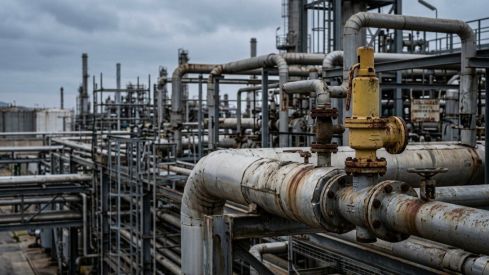
The Supreme Court has settled the distribution of the Tax on Economic Activities of the Repsol refinery and has recognized La Pobla de Mafumet's right to collect almost all of the tax generated by the petrochemical complex. The ruling, issued on April 21, closes the litigation between this municipality, Constantí, and Perafort.
The resolution creates a very wide difference between the surface area occupied by the facility in the three municipalities and the effective distribution of income. Although Constantí accounts for 16.5% of the complex and Perafort for 3.3%, both town councils will barely receive just over 131,000 euros a year compared to the more than 2.3 million that La Pobla de Mafumet will collect.
The Supreme Court attributes 2.3 million of the tax to La Pobla de Mafumet
The total annual collection of the tax amounts to 2.4 million euros. Of that amount, La Pobla de Mafumet will collect more than 2.3 million per year, 94.63% of the total.
Constantí will receive 109,411 euros annually, 4.47%, while Perafort will receive 21,951 euros, 0.90%. The ruling thus corrects the criteria previously upheld by the High Court of Justice of Catalonia.
The multinational's facilities extend over 80.1% of the municipal area of La Pobla de Mafumet, 16.5% in Constantí, and 3.3% in Perafort. This territorial distribution had sustained the discussion until now on whether the tax should be distributed in proportion to the surface area occupied in each municipality.
The ruling imposes a single settlement for the location coefficient
The High Court concludes that the Local Tax Law establishes a single settlement system for the location coefficient of the tax. This means that this multiplier can only be collected by the town council where the largest part of the industrial facility is located.
In this case, La Pobla de Mafumet set a location coefficient of 3.7. Added to this is the weighting coefficient for turnover, which increases the base fee by 35% and raises the final collection to over two million euros.
The interpretation of the High Court of Justice of Catalonia had gone in another direction by admitting a proportional distribution by surface area and the application of independent municipal coefficients. The Supreme Court now reverses this criterion and closes the conflict between the three town councils.
Constantí asks to change the law after losing the litigation
Óscar Sánchez, mayor of Constantí and leader of the PSC in the municipality, expressed his rejection of the resolution and linked the decision to the impact that his municipal term also suffers from the complex's activity.
"We have a part of the complex and we are influenced by its activity. The resolution is bad news" - Óscar Sánchez, mayor of Constantí
After the ruling, the plenary session of the Constantí town hall approved a motion to demand a legal modification from the Ministry of Finance and Public Function. The objective of the initiative is for the distribution of the tax to be done proportionally among the municipalities affected by the petrochemical facilities.
Constantí's motion proposes that the Ministry of Finance and Public Function change the rule so that the tax is distributed according to the part of the complex that falls within each municipal term.