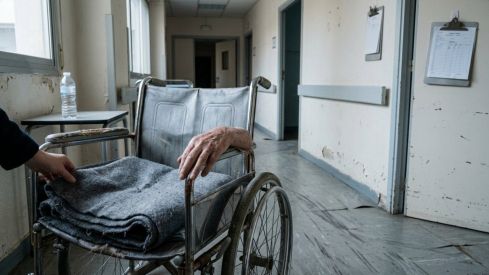
The ICASS residence in Reus closed in July 2024 due to lack of resources after months of protests from families and workers, with eight residents who held out until the end within the center. The subsequent transfer to other facilities, especially to La Mercè in Tarragona and the Horts de Miró center in Reus, keeps the conflict over the care model and the future of the building on Passeig Mata open.
The biggest fracture now appears in the human toll of the closure. Of the eight people who remained in the residence until the last day, only two are still alive after the transfer, while the reopening agreed with the Generalitat de Catalunya is not expected until 2027, at the earliest.
Eight residents resisted until the end and only two are still alive
Tarso Ros, spokesperson for the Association in defense of the Residence, maintains that the center reached its closure without basic means to continue operating. The lack of healthcare personnel and supplies precipitated an exit that families still describe as traumatic.
"They told us they only had 3,000 euros to last four days. We had no food, no assistants, no nurses, no doctor... they threw us out on the street in a bad way" - Tarso Ros, spokesperson for the Association in defense of the Residence
After the closure, most users were transferred to the La Mercè residence in Tarragona and the Horts de Miró center in Reus. Relatives and workers link this change to a loss of emotional well-being and care quality compared to the operation of the ICASS center.
Magda, a relative of one of the residents, explains that the transfer broke the daily bond with a familiar environment. Her testimony highlights the impact on the personal adaptation of elderly people who had been living in Reus for years.
"Here he was in glory, it was his home. In Tarragona he knew no one. He became depressed" - Magda, relative of a resident
Teo, a relative of a resident with Parkinson's, recounts accelerated deterioration after the change of center. In his case, he compares the care he received in Reus with what he received after the transfer.
"The change made him advance very quickly. Here he had physiotherapists, a psychologist, a doctor every day... there isn't all that there," says Teo.
The agreement sets priority for return and direct public management from 2027 onwards
The agreement reached with the Generalitat de Catalunya included three concrete commitments for the future reopening of the passeig Mata facility. Residents would have priority to return after the reform, staff would retain their working conditions and the management of the center would once again be public and direct.
That horizon, however, remains distant for families, because the reopening is not foreseen before 2027. The distance between the closure in July 2024 and that date fuels the pressure from those who demand that the new center does not move towards private or concerted formulas.
Family members and workers defend the original model of direct public management compared to what they see in other centers. Their argument is that the pursuit of profit affects the service, with less staff and constant rotation that hinders the continuity of care.
The employees were mostly redistributed to Tarragona through a labor agreement that avoided layoffs. Even so, the transfer did not compensate for the loss of the care project they were developing in Reus.
Carme Mesas, a worker at the residence, maintains that the bond with users went beyond an employment relationship. She also assures that the staff is still willing to return if the center reopens under the agreed conditions.
"Our work is an ethical commitment. It is not just a job" - Carme Mesas, worker
The mobilization of families continues with a central demand for the future passeig Mata facility. They want the new residence to be 100% public and to recover the operation the center had before the closure.
Tarso Ros, spokesperson for the Associació en defensa de la Residència, summarizes the wait with a warning linked to the construction schedule and the accumulated wear and tear on those affected. "We see the days pass and this continues to be the rosary of the dawn. In the end, we will all end up without seeing the residence built."