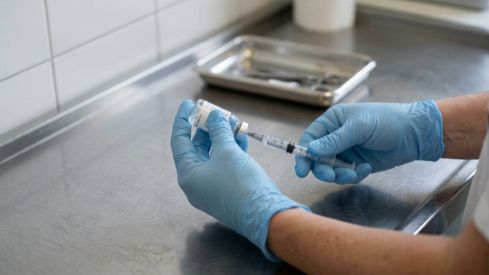
The Hospital Universitari Sant Joan de Reus has launched the first oncological phase I clinical trial in the province of Tarragona, a type of study in which a drug not yet commercialized is administered for the first time in humans. Since January, the center has been participating in research targeting the PIK3CA mutation in some breast cancers.
This leap places Reus in an area that did not exist in the demarcation until now, despite the Institut d'Oncologia de la Catalunya Sud attending to more than 3,500 new patients each year. For people included in these studies, it also avoids travel to Barcelona at a particularly delicate stage of treatment.
Four patients from Reus are participating in a trial that aims to treat about fifty people
Four patients with metastatic breast cancer and the PIK3CA mutation are participating in this first phase I trial at Sant Joan. Globally, the study aims to treat about fifty people.
Dr. Alba Cochs, a medical oncologist at the breast cancer and phase I trials unit of the IOCS, explains that it is an attractive study because the drug is very specific and there are guarantees that it can work, even though it has not yet been commercialized.
"It is an act of altruism. Even if they do not benefit, they help determine the exact dose for future patients" - Alba Cochs, medical oncologist at the breast cancer and phase I trials unit, IOCS
Phase I has different requirements than later stages. At this point, the exact dose and toxicity of the medication are still unknown, so the process starts with very low amounts and a progressive escalation to establish the correct dose and observe how the body responds.
Hospital Sant Joan already participated in phase II trials, with up to 200 patients, and phase III trials, with thousands of people. The complete journey of a medication from these studies to its commercialization can exceed a decade.
Josep Gumà argues that the industry only entrusts these studies to centers with experience
Dr. Josep Gumà, director of the Institut d'Oncologia de la Catalunya Sud, emphasizes that the pharmaceutical industry does not assign these studies to just any hospital and that centers must demonstrate experience, quality standards, trained personnel, and prepared infrastructure.
"For the patient, it is an enormous comfort. There are studies that require eight or twelve hours in the hospital, with constant analyses and controls. Having to travel to Barcelona in this situation is very hard" - Josep Gumà, director of the Institut d'Oncologia de la Catalunya Sud, Hospital Sant Joan de Reus
Inclusion in these trials follows strict criteria. Berta Caballé, nurse and clinical manager of the clinical trials unit at IOCS, points out that the patient is only proposed to enter the study if they meet the established conditions, and that if they do not accept, they continue with the standard treatment.
Furthermore, participation is voluntary and can be interrupted at any time. Cochs adds that oncology is moving towards increasingly precise and targeted treatments.
The hospital is building a new unit to concentrate phase I, II, and III trials
The deployment of these studies coincides with the construction of the future Clinical Research Unit of IRB CatSud, formerly Institut d'Investigació Sanitària Pere Virgili, within Hospital Sant Joan. The new space will concentrate oncological clinical trials of phases I, II, and III.
IRB CatSud and Hospital Sant Joan obtained a grant from the Carlos III Health Institute to promote new clinical study units in the territory. Within this framework, IOCS oncologists develop the trials, and the research institute assumes technical support and contractual and economic management.
IOCS plans to apply for all possible phase I trial calls and request more resources if the volume of studies requires it.