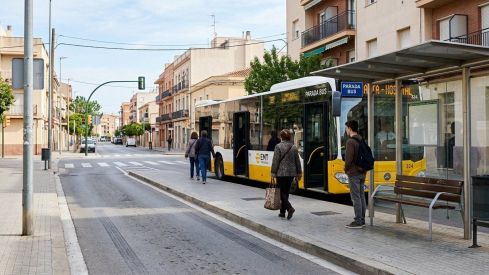
The rearrangement of Tarragona's urban buses, which will affect 17 lines, will be presented between October and November with changes that in some cases will be significant. The plan, which the Municipal Transport Company of Tarragona has been working on for more than a year together with the consultancy Aie Multicriteri Mcrit, foresees its implementation in the fall if it passes the next municipal procedures.
The proposal was already presented in January and will now take a new step on May 6, when it will be presented before the Territorial Information and Monitoring Commission. Afterwards, the municipal government plans to submit it to the plenary session this same month. The routes for each line have already been published on the EMT website.
A redesigned network with changes in neighborhoods and key connections
The president of the EMT, Sònia Orts, maintains that the final document incorporates a good part of the contributions gathered during the round of meetings with neighbors and political groups. The EMT assures that it has integrated around 80% of the requests made.
"Around 80% of the requests made by residents and politicians during the round of meetings have been incorporated" - Sònia Orts, president of the EMT
Orts also highlights as one of the central objectives of the reform to improve the proximity of the service. 9 out of 10 inhabitants of Tarragona will have a stop less than five minutes' walk from home, according to municipal forecasts.
"One of the main advantages of the rearrangement is that 9 out of 10 city residents will have a stop less than a five-minute walk from their home" - Sònia Orts, president of the EMT
The EMT also calculates that the new planning will allow for an additional 8,000 trips per year. The deployment will be accompanied by an intensive information campaign before it enters service.
Reinforcement in Sant Salvador and in the Poniente neighborhoods
In Sant Salvador, the L5 and L85 will improve the connection with the Joan XXIII Hospital, with direct access from both lines and in both directions. The L85 will go from 2 to 3 buses, will increase from 57 to 81 daily departures to the neighborhood and will reduce its interval to 20 minutes. Its route will also be adjusted to improve the link with the CAP of Sant Ramon and the Institut Pont del Diable.
On the L5 a new stop will be incorporated in Santa Isabel towards the center and the passage interval will be 30 minutes. The night line L71 will reach Interblocs and will maintain the same coverage throughout the year, with more frequency in winter.
The rearrangement also concentrates a significant part of the changes in Poniente, with improvements in frequency, accessibility, and direct connections in Icomar, Riuclar, La Granja, l"Albada Parc Riu Clar, Bonavista, Torreforta, La Floresta, and Campclar. The L34 will directly connect La Granja, Torreforta, and La Floresta, will reinforce cohesion between neighborhoods on both sides of the T 11, will add expeditions on Sundays and holidays, and will incorporate one more bus.
The new L54 will connect Bonavista with the center and Sant Pere i Sant Pau. It will pass through Josep Maria Recasens avenue and will serve the new hospital, the Mediterranean Ring and the future developments in the area. In parallel, the service will be reinforced to double the capacity in Riu Segre, an area with high demand. This new route will also improve the direct connection of Riuclar and Icomar, with fewer transfers and less waiting.
The proposal for the L3 increases direct departures from Bonavista towards the center. The L43 will add two expeditions in the afternoon to facilitate student travel to the Complex Educatiu. The night line L72 will have more frequency in winter on Fridays, Saturdays and holiday eves. The L41 will extend its coverage early in the morning from Monday to Friday to facilitate access to the train station from Poniente, Norte and the center.
Llevant and Sant Pere i Sant Pau win connection with the station
The L6 will maintain its current route, without being divided into two branches, and will keep its frequency of 12 minutes. On the other hand, the L55 will be extended to improve the connection of Sant Pere i Sant Pau and the Mas d"en Pastor area with the center through a more direct route towards the surroundings of Reial street and the train station. This line will also incorporate an additional bus to improve frequency.
In Llevant, the L13 will be extended to the train station and the first morning departures on weekdays will be adjusted to facilitate students' arrival at institutes and schools. The L73 night line will extend coverage to La Mòra year-round and increase its frequency in winter. It will also add three more round-trip night departures from the center and Llevant on Fridays, Saturdays, Sundays, and the eve of holidays during the winter schedule.
In this same area, the new L20 will be created, the result of the merger of lines L21 and L23, with the aim of improving the frequency and operational efficiency of the circular routes. The L22, for its part, will be extended in summer to Miracle beach, in the vicinity of the Marina.
The limit of resources conditions some proposals
The management of the EMT has ruled out the possibility of extending some lines to industrial estates, an option proposed by En Comú Podem. Both Sònia Orts and the municipal company's manager, Juan Manrubia, argue that this measure is not viable with current resources.
Both maintain that legislation prevents a municipal company like EMT from increasing staff and that the scope of action has involved reorganizing already available resources. With that condition, the plan focuses on redistributing buses, modifying routes, and adjusting frequencies to expand coverage and improve connections between neighborhoods, hospitals, educational centers, and the train station before its anticipated launch in autumn.