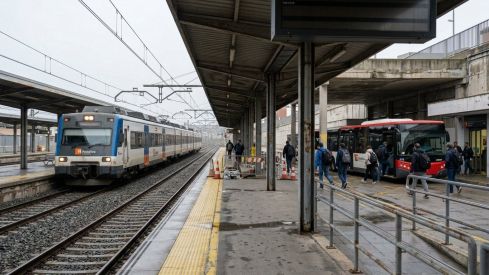
The Rodalies and Regional rail network in Catalonia will be subject to payment again starting May 9 if no last-minute changes occur. The Minister of Territory, Sílvia Paneque, confirmed the date after assuring that the system has already recovered 90% of its usual travelers.
That day, almost 110 days will have passed since the Gelida accident that cost the life of a trainee driver. Since then, the Generalitat imposed the gratuity of the service as a compensatory measure until reaching sustainable operational normality.
Partial recovery of key lines
This week the recovery of the full section of the R4 line comes into effect, which eliminates the shuttle between Terrassa and Manresa. The R3 line will extend its route to Ribes de Freser, although until now it only operated between La Garriga and Ripoll.
The R15 line will run from Reus to Móra la Nova after being cut off for three and a half months. The sections between Ribes de Freser and La Tor de Carol on the R3 and between Móra la Nova and Riba-roja on the R15 remain out of service.
In these affected areas circulate approximately 50% of the trains and the replacement buses are maintained. Users must show the corresponding ticket or pass for the affected section but will not be able to purchase it on the bus.
The purchase must be made via the Internet or at the destination station. This situation complicates access at many stations on the affected routes that lack staff or ticket machines.
"We cannot accept being made to pay because we already paid with our health" - Anna Gómez, spokesperson for Dignity on the Tracks
User platforms criticize the return to charging while structural deficiencies persist. Montse Ayats, spokesperson for the R3 user platform, stated that it is not a political measure but the consequence of trains that do not function correctly.
Speed limits and urgent works
Anna Gómez denounced that the reopening occurs with 12 speed limitations, double what the Generalitat admitted. The Adif map reflects up to six sections where trains cannot exceed 30 km/h and one more limited to 20 km/h.
An unforeseen closure has affected the R13 for two months between Sant Vicenç de Calders and la Plana Picamoixons due to tunnel emergencies. The infrastructures were inaugurated almost a century and a half ago and show visible cracks in some places.
R13 works will extend until July 6 and include maintenance of two tunnels and urgent actions in two others. The Rubí tunnel reached a risk of collapse, which forced the closure of traffic for several weeks and blocked the transit of goods.
Although one track was reopened, the second will remain closed until the end of June. Nil Magrinyà, president of the Association of Friends of the Railway of Valls and l'Alt Camp, considered the closure necessary but criticized the planning.
"Schedules and alternative service were planned hastily, late, and poorly" - Nil Magrinyà, president of the Association of Friends of the Valls Railway
The entity fought to guarantee at least one direct bus between the region's capital and Sants station. Renfe sources confirmed that payment will also be required if the service is offered by road.
Renfe data indicates that 96% of the supply is available and 90% of regular passengers have returned. It is expected that the R8 will be able to recover full service up to five months after the Gelida accident.
Buses continue to be essential on the R3 in a section of the R8 and on practically all of the southern Regional lines. In some cases, the road service is far from the station, forcing travelers to make additional trips to access public transport.