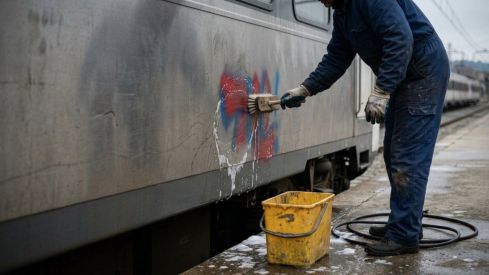
The Sant Vicenç de Calders station has accumulated 21 graffiti incidents since the beginning of the year and is among the most affected points on the Catalan railway network. Renfe has responded with increased night surveillance, drones, and a pilot test with a canine unit to try to curb intrusions that affect both the service and rolling stock.
The paradox lies in the daily impact of graffiti that not only forces trains to be cleaned but also leaves trains out of service. Renfe calculates that an average of two trains are immobilized each day because the graffiti affects the visibility of the drivers, an alteration that during the past year affected about 1.4 million passengers with delays, schedule changes, or reduced capacity.
Sant Vicenç de Calders registered 21 cases and was among the most affected stations
The Sant Vicenç de Calders record places it below Montcada-Bifurcació, with 31 incidents, but at levels close to Estació de França in Barcelona, with 23, and Cornellà and Granollers Centre, with 22 each. The concentration of cases confirms the pressure on several railway nodes in the Barcelona area and Camp de Tarragona.
In Catalonia as a whole, Renfe filed 970 complaints for graffiti during 2025. That activity required cleaning 55,100 square meters of surface area on trains and increased the cost to 7.4 million euros.
In addition to the expense, graffiti disrupts daily operations. When they affect cabins or areas that compromise visibility, Renfe must remove the train, activate reserve trains, or modify the planned composition to maintain circulation.
Renfe deployed night drones and will open a cleaning point at the station
To try to contain the intrusions at Sant Vicenç de Calders, Renfe has reinforced surveillance with six dynamic night services. The company has also incorporated drones to detect unauthorized access in the railway environment.
The reinforcement includes a pilot test with a canine unit and the future installation of volumetric and infrared cameras. These systems will allow drones to be activated automatically when they detect suspicious movements.
Catalonia now has five graffiti cleaning points spread across Ripoll, Sant Andreu, Estació de França, L'Hospitalet de Llobregat, and Vilanova i la Geltrú. The network will be expanded with new facilities in Reus and Sant Vicenç de Calders, in an area where the Sant Vicenç de Calders station already concentrates several operational incidents.
Renfe maintains that a large part of these acts are committed by organized groups that travel specifically to paint trains and places Catalonia as one of the main focal points of this activity. In parallel, cleaning has gained speed with new products, as already happened in new railway facilities linked to maintenance.
With these products, the time needed to remove graffiti has gone from one hour to 15 minutes.