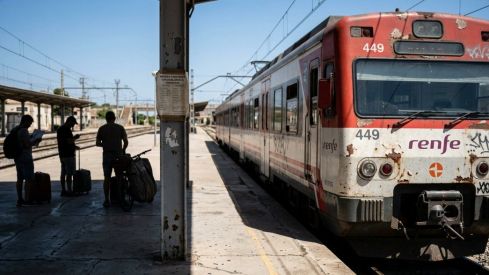
Renfe already has the prototype of the new medium-distance trains that are intended to renew part of the Catalan fleet undergoing tests, but their arrival in Catalonia is not expected before the end of next year. The model is currently running on a closed circuit in the Czech Republic, as part of the contract awarded to CAF in October 2022 to manufacture 28 trains for 183 million euros.
The renovation, however, creates a paradox on the southern corridor. The plan will allow for the retirement of 33 old trains, but the net balance will be only five more trains than the current ones, on a line where, moreover, several lines will not be able to take advantage of the new units in double composition due to the lack of adapted platforms.
The prototype is already running, but the 24 units for Catalonia will still take at least a year
David Cortés, spokesperson for Dignitat a les Vies, maintains that the testing phase should proceed quickly because CAF will subsequently send these same trains to Germany and the Netherlands. Before mass production, Renfe and the Railway Safety Agency must complete the homologation and also the training of the drivers.
"The tests are expected to be quick, as they are the same trains that CAF will also send to Germany and the Netherlands later" - David Cortés, spokesperson for Dignitat a les Vies
The new trains will be 100 meters long and, according to the Rodalies Plan of Catalonia, will provide 6,384 seated places. They will also reserve more space for bicycles and luggage.
Cortés explains that they will be a modern version of the 449 series, with all doors and the interior at platform level. The Generalitat will later decide how they are distributed, although the commitment conveyed to the group is to allocate them entirely to the southern corridor.
This distribution is one of the demands of the platforms in the territory. Cortés recalls that in the 2008 renovation, the new 449 series trains were sent to Girona and Tarragona received older rolling stock from there, so he argues that the movement should now be in the opposite direction.
The renovation will remove 33 trains, but lines R-13, R-14, and R-15 will continue with capacity limits
The fleet replacement will allow for the retirement of seventeen units of the 448 series, in service since 1987, and another sixteen of the 470 series, incorporated between 1974 and 1986. After this replacement, only the 447 and 449 models will remain in circulation.
The problem for the southern lines is not entirely resolved. The new trains will not be able to run in double composition on the R-13, R-14, and R-15 because many stations do not yet have platforms adapted for that length.
Cortés also adds that the current rolling stock presents operational limitations at intermediate stops. In his diagnosis, the boarding and alighting process is very slow, because there is only one door per carriage.
To that renovation will be added 14 second-hand trains from the S-121 series from Galicia. These units will be reserved for the R-16 between Tortosa and Barcelona, as they can run on dual gauge.
Dignitat a les Vies maintains objections to that reinforcement. Cortés states that the S-121 are not accessible and the group has requested a mid-life overhaul to adapt them to European regulations, a process that has not yet gone out to tender.
The improvement of frequencies in Valls also depends on the trains that become available with the transfer to FGC
On April 8, Manel Nadal, Secretary of Mobility and Infrastructure, committed to the mayors of the R-13 and the group Propera Parada Valls to increase the line's frequencies. The possibility of doing so also involves reorganizing the available rolling stock in the coming months.
By the end of the year, the entry of FGC into the Lleida-Terrassa line should free up between three and four Renfe trains, with the intention of reinforcing the service from Valls and the rest of the capital of Alt Camp.