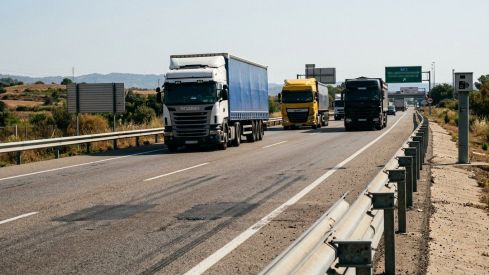
Trucks are involved in 41.7% of serious accidents registered on the AP 7 sections in Tarragona, although they represent 29.9% of total traffic. The pressure of heavy transport on this highway is once again reflected in the Risk Map of the road network of the Tarragona regions, which analyzes the period between 2022 and 2024.
The report, prepared based on 97 accidents with fatalities or serious injuries on the Tarragona road network, places some of the most sensitive points on the AP 7 and also on conventional roads with a significant presence of heavy traffic. Tarragona also appears as the second province with the highest percentage of serious heavy vehicle accidents on the AP 7, behind Girona, with 53.3%, and ahead of Barcelona, with 38.7%.
Two stretches of the AP 7 concentrate a good part of the risk
One of the most relevant data points is located on the stretch of the AP 7 between the Vilafranca junction and the Altafulla junction, 39.5 kilometers long. On that route, 62% of serious accidents correspond to trucks, a proportion much higher than the average for the entire highway in the demarcation.
Also noteworthy is the stretch between Cambrils and Tortosa, of 54.7 kilometers, where 43% of serious accidents involve the presence of heavy vehicles. These are two especially monitored sectors within a road that continues to absorb a very important part of long-distance mobility in Tarragona.
The N 340 in Torredembarra and two roads of the Camp, under focus
Outside the highway, the N 340 as it passes through Torredembarra appears as the point with the most serious heavy vehicle accidents in the entire province. The map also places the T 312 between Cambrils and Montbrió del Camp, on an 8.3-kilometer stretch, as the third point with the highest concentration of accidents involving trucks.
In parallel, the T 314 between Cambrils and Reus, with 7.3 kilometers, appears as the sixth stretch with the highest risk of suffering an accident with any type of vehicle in all of Catalonia. The combination of local traffic, metropolitan mobility, and heavy vehicle circulation keeps this axis among the most sensitive in the territory.
The RACC points to the end of tolls and demands to expand capacity
"The problem is caused mainly by the liberation of tolls" - Josep Mateu, president of the RACC
The president of the RACC maintains that the AP 7 currently bears a demand above its capacity. Along those lines, he demands more resources to facilitate the circulation of professional transport.
"We must provide more tools so that transporters can circulate with greater comfort on the highway" - Josep Mateu, president of the RACC
Mateu insists that the infrastructure requires deeper actions. In his opinion, the situation will not be resolved solely with traffic management measures.
"It is being asked much more than it can give, and that requires investment in lane widening, in maintenance, in new entrances and exits, in different links... and that in the short term we will not have it, that's why measures are implemented to improve day by day, but in the end the AP 7 will have to be widened" - Josep Mateu, president of the RACC
Traffic defends control measures and mortality reduction
The Catalan Traffic Service has deployed artificial intelligence measures, variable speed and radar control with the aim of reducing truck accident rates. From the territorial service of Tarragona, the focus is placed on the evolution of mortality and on reinforcing surveillance over speeding.
"We are satisfied because the number of deaths has been reduced; I also want to highlight the work done by the Catalan Traffic Service with the ten trailer radars that verify and control speeding" - Albert Raül, head of the Tarragona Territorial Traffic Service
Raül also points out that, despite the high volume of traffic, the highway maintains better records than other interurban roads.
"The AP 7 is a safe road because, despite having a lot of traffic, the accident rate is small in comparison with conventional roads" - Albert Raül, head of the Servei Territorial de Trànsit de Tarragona
The diagnosis leaves a double reading in Tarragona. The AP 7 concentrates a very relevant part of serious accidents with trucks and several sections remain under pressure, but at the same time it continues to be the main axis on which regulation and control measures are based to contain an accident rate that is particularly concerning in heavy transport.