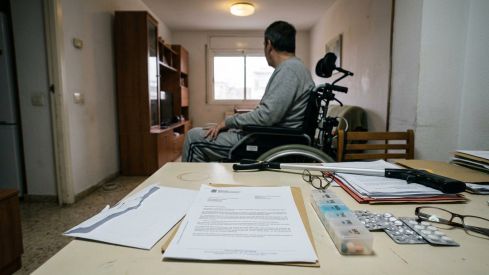
Lluís Boada, a Psychology student at the Rovira i Virgili University of Tarragona, has received a claim for 4,251.30 euros from the Department of Social Rights and Inclusion for alleged undue payments of the Dependency Law benefit. The debt corresponds to a period of more than two years in which his monthly allowance went from 387 to 228 euros, although he continued to collect the previous amount without being notified of the change.
Boada, 23 years old, suffers from laminopathy, a rare congenital disease that causes severe muscular dystrophy, loss of head control, respiratory insufficiency, and cardiac anomalies. He has a recognized 78% degree of disability and the need for a third person.
"It seems like a joke that they give you 100 euros less and on top of that they make you return money because they made a mistake from the administration" - Lluís Boada
A claim with notice of surcharges
The letter sent by the Department warns that, if the amount is not paid within the fixed voluntary period, the file will be transferred to the Catalan Tax Agency. That step would increase the debt with surcharges and may also entail late payment interest.
The young man assures that he is unaware of the reason for the reduction of the benefit. He explains that the received letter refers to seven articles of orders and decrees, but does not clarify in a comprehensible way why the aid was reduced. Even so, he maintains that he will pay the claimed amount.
"I understand that by law the money has to be returned, but I believe it is necessary to express our discontent when injustices occur" - Lluís Boada
Benefits review underway
The Departament de Drets Socials i Inclusió points out that it is immersed in a review process of the benefits that can generate undue payments. The objective, points out the administration, is to detect these situations as soon as possible, when they begin to occur, to prevent the amounts to be returned from representing a grievance for the families that have received them.
The Generalitat adds that it is working on the digitalization of the Department and on improving the interoperability of applications to facilitate and streamline the monitoring and verification of benefits, as well as changes in the situation of beneficiaries. It also indicates that it is reviewing the websites, procedures, and texts that are sent to citizens to make them more understandable and accessible.
The current amount of the aid
Boada currently receives 228 euros monthly from the dependency benefit and 745 euros monthly from the Ministry of Inclusion, Social Security and Migration. Her mother currently works as a non-professional caregiver.
The student focuses on the amount of the aid more than on the required repayment. He/She considers that the underlying problem is that it is taken for granted that a person with their degree of disability and need for permanent support can maintain minimum conditions of dignity with that monthly amount.
"The main problem is not money, but that someone believes that a person with a 78% degree of disability and with the need for a third person can live with a minimum of dignity with only 228 euros per month, plus 745 euros monthly from the Ministry of Inclusion, Social Security and Migration" - Lluís Boada
The young man also expresses his concern for the future of his care given the aging of his parents. He recalls that with an income close to one thousand euros per month, the cost of an assistant cannot be afforded, and even less so if basic expenses such as housing, food, or utilities are added.
"They are getting older and at some point they won't be able to help me. With only a thousand euros, neither I nor anyone in need of a third person can live. Just the salary of an assistant, not counting a possible rent, food or electricity, is already much higher than what we receive" - Lluís Boada
Two years ago she had already claimed to be able to count on transport and an assistant to attend the URV. After that request, the Generalitat assigned her both supports. Now, with the economic claim on the table, she again puts the focus on the difficulties of access and on the insufficiency of some benefits that, she maintains, are far from covering the real needs of a dependent person.