Tarragona already has a thermal map that locates the urban surfaces that overheat the most during heatwaves. The research, elaborated by the Universitat Rovira i Virgili, points out industrial, commercial and transport areas as main hot spots, and detects very marked contrasts between materials and land uses in different points of the city.
The work is signed by Caterina Cimolai, predoctoral researcher at the Center for Climate Change and the Institut Universitari de Recerca en Sostenibilitat, Canvi Climàtic i Transició Energética, and Enric Aguilar, director of the C3. The study has recently been published in the journal Atmosphere.
A map of Tarragona during the heat waves
To elaborate the analysis, the researchers selected the periods of heat waves recorded in Tarragona between 2015 and 2025 from data from AEMET and Meteocat. Afterwards they used different satellites to measure the daytime and nighttime temperature of the surfaces and observe how each zone responds when the thermometers rise.
The result allows to identify in detail which spaces accumulate more heat and which act as thermal relief areas. The Francolí industrial estate, several commercial and transport surfaces and highly impermeable urban enclaves appear among the clearest hotspots on the map.
Among the specific points that stand out are the surroundings of Plaça Imperial Tarraco, the train station, the roofs of the Parc Central shopping center, and the Port. At night, furthermore, the city retains the heat accumulated in buildings and asphalt, which reinforces the effect of nocturnal urban heat island.
The annex field of Nàstic, among the hottest surfaces
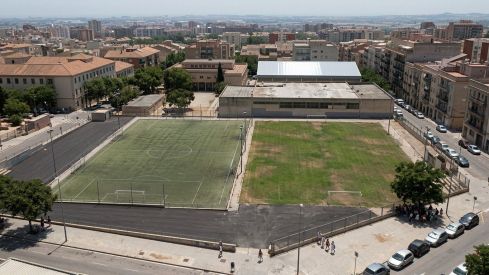
One of the most striking cases appears next to the Nàstic facilities. The annexed field, covered with artificial turf, appears as one of the surfaces that heat up the most. The study points out that in the hottest moments there can be more than ten degrees of difference compared to the natural grass field located right next to it.
The work also observes differences between the cultivation zones and the urban areas. During the day, the dry cultivation soils reach higher temperatures than the city itself, while at night the urban core retains better the accumulated heat.
Vegetation, water and light-colored coverings as a brake to overheating
The research confirms an inverse correlation between surface warming and the presence of vegetation. The Parc del Francolí, dense peripheral forests, and proximity to seawater function as cooling islands. In the Llevant area, the few wooded areas appear among the coolest areas both day and night.
The effect of albedo is also appreciated, that is, the capacity of a surface to reflect radiation. In that sense, the roof of the Tarraco Arena Plaça, due to its light color, presents less thermal accumulation than other large roofs in the city.
"That's why, in some areas where it's hot, they paint the houses white, because a lot of energy is reflected" - Caterina Cimolai, predoctoral researcher of the C3 and IU RESCAT of the URV
One of the measures proposed by the study is to promote cool roofs or high-reflectivity materials. The authors consider that it is one of the most cost-effective mitigation strategies for the city.
Climate shelters and connected green areas
The analysis also focuses on the real utility of green spaces as a refuge against extreme heat. Regarding the Parc de la Ciutat, Cimolai warns that it offers relief, although with limitations due to its coverage.
"It represents a refuge, in inverted commas... but in terms of efficiency it lacks a bit of coverage" - Caterina Cimolai, predoctoral researcher of C3 and IU RESCAT of URV
The researcher advocates for a connected planning of green areas to improve their effectiveness and avoid isolated actions without urban continuity.
"It's not enough just to plant trees, trees must be planted in a way so that they function efficiently... If we do fragmented things and put a small park on one side and, five streets away, another, we have a very great inefficiency" - Caterina Cimolai, predoctoral researcher of C3 and IU RESCAT of the URV
In the same vein, it emphasizes that climate shelters must be accessible and close to the population, especially during episodes of intense heat.
"It is very important that shelters exist in cities, but also that these shelters are accessible and that people can reach them. If there is a shelter, but people have to walk 10, 15, 20 streets, it doesn't make much sense" - Caterina Cimolai, predoctoral researcher at C3 and IU RESCAT of the URV
The thermal map thus provides a precise X-ray of how heat is distributed in Tarragona and opens the door to intervene on roofs, pavements, and green areas in the points where the city most overheats during heat waves.