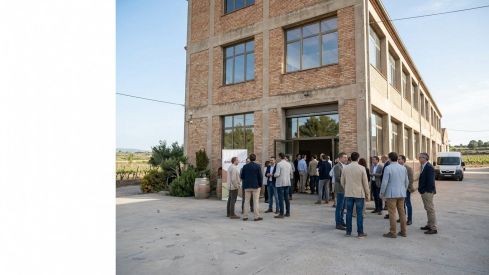
The Department of Research and Universities has presented ENOLAB.CAT during the inauguration of the thirty-first edition of the Falset Wine Fair. A public investment of four million euros will allocate these funds to create an infrastructure that integrates the production process, research, and data analysis in a single facility. The space will be located in the old Falbar textile factory, a building situated in the Tarragona municipality.
Technological architecture for the wine sector
The launch has been communicated within the framework of a new stop of the infotruck of the Government Plan. The delegate of the Government in Tarragona, Lucía López, has participated. The facility will occupy more than a thousand square meters and will be divided into two strategic lines. The first focuses on the digitalization of enological processes through advanced sensors and predictive models to optimize fermentation and aging. The second focuses on sustainability with measures to reduce the environmental footprint and improve resource consumption efficiency.
Institutional synergies and analytical capacity
The initiative has the support of the regional department, the Institute of Agrifood Research and Technology, VITEC, and the Falset City Council. The center will open to cooperation with wineries, companies, and research centers to function as a technological transfer platform. Its operational core will include a fully sensorized experimental winery, chemical and microbiological laboratories, as well as a digital platform based on artificial intelligence. This tool will study all stages of production in real time and generate predictions. To manage the large volumes of data, collaboration with the Barcelona Supercomputing Center has been confirmed.
"Puts science, data, and innovation at the service of a strategic sector" - Núria Montserrat, Minister of Research and Universities
"From a fragmented investigation to an integrated and precise model" - Josep Usall, CEO of IRTA
Catalonia has twelve designations of origin, more than seven hundred and fifty wineries, and an annual turnover exceeding twelve hundred million euros. This productive landscape reinforces the need for modern tools to safeguard competitiveness. The Falset council celebrates the arrival of the project as an engine to boost the local economy. The authorities are now working on the execution deadlines to turn Priorat into a European benchmark for digital oenology.