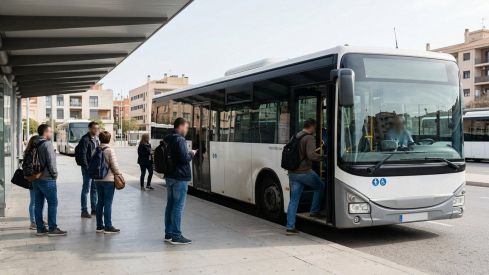
The Government will approve on April 28 a second shock plan to reinforce road passenger transport in Catalonia, with a notable action in Tarragona. The measure foresees improving the offer on 22 interurban bus lines in the demarcation to absorb the increase in demand derived from the Rodalies crisis.
The reinforcements will be concentrated on the corridors with the most users, especially on the connections between Tarragona and Reus, Tarragona and Barcelona, El Vendrell and Barcelona, and Tortosa and Tarragona. The objective is to increase the capacity of the regular services during this same year, once the reinforcements for the different lines have already been defined.
An investment of 4.8 million in Tarragona
The secretary of Infrastructure and Mobility, Manel Nadal, has estimated at 4.8 million euros the planned investment for improvements in the demarcation of Tarragona. In Catalonia as a whole, the second shock plan amounts to 21.5 million euros.
In addition to the lines with the highest demand, this year actions will also be taken on services that were already planned. These include Tarragona and Reus Airport, Vespella de Gaià and Tarragona, Salou, La Pineda and Tarragona, L"Hospitalet de l"Infant and Mont roig, in addition to improvements linked to the mobility study of Conca de Barberà.
"We have to make a bus plan, improve rail services and there is also the tram, which is decisive" - Manel Nadal, secretary of Infrastructure and Mobility
Immediate reinforcements and medium-term planning
Nadal has defended that these reinforcements must be accompanied by a plan for public passenger transport services that is already being drafted for all of Catalonia and that, in Tarragona, work is being done with the Diputació. He has also advocated for promoting the law of the Metropolitan Area of Tarragona to give it powers in the area of transport.
The head of Mobility has admitted that this law will still take a few years to be approved, so, in the meantime, the priority is to strengthen the current offer. In parallel, he has advanced the intention to launch pilot tests of new bus lines, two or three, agreed upon with different municipalities and designed so that in the future they can be managed by the AMT.
Longer concessions in exchange for less polluting buses
The Generalitat has also decided to extend up to a maximum of six years the concessions for interurban bus services that expired in 2028. This extension will be conditioned on the decarbonization of the fleets and the improvement of the service.
Through a decree-law, the Executive will oblige concessionary companies to present a project with their renewal plans within three months if they want to maintain the exploitation. The Generalitat will then have another three months to review the proposals. If they meet the requirements, the plans must be in place before the end of the year. If they do not meet them, the lines will go out to tender.
Target of 75% decarbonized fleet in 2029
The new model sets a goal that by January 1, 2029, 75% of the fleet will be decarbonized, which would mean that around 1,425 buses will run on clean technologies. Currently, of the 1,597 vehicles in service, only 25 are electric, 1.6% of the total.
The decree also incorporates operational improvements, including the implementation of real-time information systems so that users can know the location of buses and waiting times. The investment associated with this transformation is estimated at 762 million euros, an amount that will be borne by the operating companies in exchange for amortizing it within the new concession periods.
With this package of measures, the Government seeks to respond to the pressure on the railway network and, at the same time, accelerate the modernization of interurban buses, especially in areas with high daily mobility such as Camp de Tarragona and connections with Barcelona.