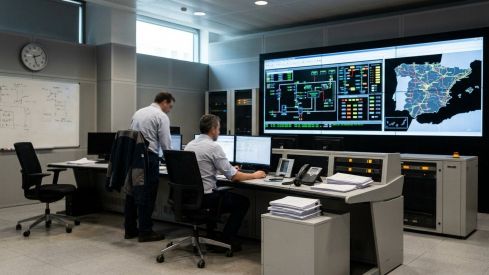
The massive blackout that left peninsular Spain and Portugal without supply on April 28, 2025 at 12:33 hours, the first electrical zero recorded until now, had its origin in a tension problem with a multifactorial nature and not in a cyberattack. That is the coinciding conclusion of the known technical reports on the system's collapse.
The investigations reviewed by the committee led by the Ministry for Ecological Transition, Red Eléctrica, Aelec, the European panel of experts from Entso e and the National Commission for Markets and Competition place the focus on overvoltage and on the lack of effectiveness of voltage control. The cyberattack route was discarded and archived.
Coincidence in the voltage failure
The different analyses converge on a central idea. The event responded to a tension problem and a chain of factors that ended up unbalancing the system. Renewable production, by itself, was outside the cause, according to the technical information disseminated.
For the committee headed by Transición Ecológica, that April 28, voltage control capabilities were lacking, either because they were not sufficiently programmed, a task attributed to Red Eléctrica, or because the facilities called upon to provide them did not adequately contribute what was required by the regulations, a responsibility that affects companies, or due to a combination of both circumstances.
Red Eléctrica, for its part, maintained in its report that the blackout could have been avoided if the power plants obliged to provide voltage control capacity had not failed. The energy companies replied that the operator did not activate the available resources to curb the fluctuations that, they maintain, would have been detected before the collapse, and added that the ordered capacity was insufficient and was poorly distributed.
The European experts point to the lack of effective control
The European panel of Entso e identified as a key phenomenon the lack of effectiveness of voltage control. Its conclusion points to that larger margins of reactive power could have avoided the system's collapse. Along the same lines, the CNMC placed the origin of the incident in a multifactorial scenario after a temporal series of events that ended up breaking the network's balance.
The CNMC also detected signs of infringements of the sectoral regulations maintained during prolonged periods, facts that, although they would not explain the blackout by themselves, must indeed be formally investigated. Based on that assessment, the body has opened half a hundred sanctioning files.
- Red Eléctrica, for a possible very serious infringement
- Centrales Nucleares Almaraz Trillo, for a possible very serious infringement
- Iberdrola, Endesa, Naturgy, Engie, TotalEnergies and Repsol, for possible serious infringements
Previous warnings and crossing of responsibilities
Aelec's report maintained that the scenario of strong voltage fluctuations and overvoltages was not new. In fact, it reported incidents on April 16, 22, and 24, just a few days before the cero eléctrico. In the Senate, Endesa's CEO, José Bogas, spoke of a first significant incident at the beginning of 2025.
"After that, the company sent a letter to Red Eléctrica requesting a meeting of the Incident Analysis Group and the response was that it did not consider it necessary" - José Bogas, Endesa
In that same commission, the PP approved with its majority a report that describes the blackout as the outcome of a structural fragility known beforehand. The senator of Geroa Bai, Uxue Barkos, defended that one cannot speak of an unpredictable episode because, in her opinion, there were alarm signals, among them the exponential growth of overvoltage episodes in recent years.
The Government maintains that there were no previous warnings of cut
The third vice president, Sara Aagesen, has reiterated that it was an unprecedented and unexpected incident. The Executive maintains that it had no alerts that a supply interruption could occur, despite the open debate about previous warnings and about the management of voltage control resources.
In the Congress, the executive president of Naturgy, Francisco Reynés, summarized the impact of that day with a brief phrase.
"It was a long day and a long night" - Francisco Reynés, Naturgy
Reynés also highlighted the role of combined cycles and hydroelectric power plants to lift the electrical system after the peninsular zero. With the general causes already delimited around the overvoltage and the failure in voltage control, the investigation now remains focused on clarifying technical and regulatory responsibilities for an episode without recent precedents in the peninsular electrical grid.