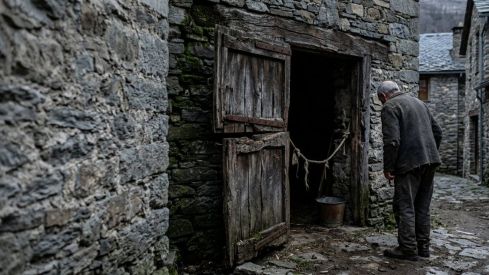
Roberto Bustos Morales spent a decade on a farm in Viu de Llevata, in Alta Ribagorça, with a name that was not his and without salary for the days he claims he worked since childhood. Today, from the residence in Castejón de Sos, he maintains that he was handed over by the Casa Sant Josep of Tarragona to a married couple of livestock farmers under temporary foster care and that he lived there "like a slave".
The paradox of his case appears in the very papers that supported that handover. Francoist legislation allowed a minor to remain with a family until adulthood without a contract or financial compensation, a formula presented as foster care and which, in Bustos's account, ended up separating him forever from his three siblings and erasing his identity for years.
Roberto Bustos discovered when he went to the army that his name was not Andrés Muñoz Alcolea
Bustos explains that he left the orphanage when he was ten or eleven years old. "They came to get me out of the orphanage when I was ten or eleven years old. In February I turned 73, so do the math on how much time has passed," he recounts from the residence in Castejón de Sos, in Ribagorça.
During that time he lived in Viu de Llevata under the identity of Andrés Muñoz Alcolea. His real name was Roberto Bustos Morales, born in Madrid on February 3, 1953, son of Felisa and an unknown father, a detail he learned when processing the documentation when he was called up for military service.
Until then, he assures, he had been set aside from his brothers José, Manolo, and Gregorio. He also maintains that the name change did not match either his mother's surnames or those of the family that took him in at the hacienda.
The Casa Sant Josep of Tarragona, founded in 1912, was run in the 60s by mossèn Prefecte Cabré. It was that center that handed over the minor to the couple of ranchers from Viu de Llevata through the figure of temporary foster care or family placement provided for by the regulations of the time.
Legal reception did not include contract or salary and Bustos recounts shifts in the stable until dawn
According to that legal figure, the Tutelary Court could entrust a child to a family until their majority without a contract or economic compensation. Bustos states that in practice this meant working in exploitation without pay for ten years.
In her account, the days began at five in the morning and could last until eleven at night or one in the morning. She says she slept in the stables when an animal gave birth and that she worked from Monday to Sunday with about 50 cows, which she milked, fed, cleaned, and took to the mountains.
"Adoptive parents don't make you work from five in the morning until eleven at night. Sometimes it was one in the morning and I was still in the stable" - Roberto Bustos Morales
Bustos also describes a life separate from the rest of the house. He says that the family ate in the dining room while he ate in the kitchen, that sometimes he did not receive the same food and that they hid him when friends arrived. He adds that at first they didn't even take him to school.
The foster mother offered a different version when she was interviewed at her home in El Pont de Suert at 86 years old. She stated that the minor had arrived for a "temporary adoption" managed by a priest from Tarragona, a friend of the family, and denied that he had been treated as labor.
"We treated him like a son and he was very happy in our home until some neighbors from the village filled his head with nonsense and started telling him that we were using him like a slave" - foster mother interviewed in El Pont de Suert
The woman also maintained that they kept the documentation and that "we did everything legally". In her account, mossèn Prefecte Cabré had explained to her that the child's father was going to pick him up, hit him, and take him to beg for alms before returning him to the orphanage.
After learning who her true identity was, she began a sixty-year search to locate José, Manolo, and Gregorio. That journey began after she was rejected when she tried to ask for information at the door of the orphanage in Tarragona.