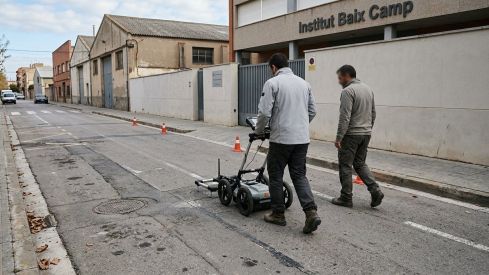
The work to locate the possible Francoist mass grave of Reus has begun this Tuesday, March 31, on Jacint Barrau street, where two specialized technicians have started a georadar prospecting to try to identify anomalies in the subsoil compatible with an old industrial well.
The intervention takes place between March 31 and April 2 commissioned by the Directorate General of Democratic Memory, which is trying to pinpoint the location of a well that, according to the working hypothesis, would have been used as a mass grave during the entry of Franco's troops into Reus, in January 1939.
Prospecting without lifting the asphalt
The methodology used does not involve opening the street or removing the pavement. The work is based on the analysis of the subsoil's intensity to then elaborate an echo map that allows detecting irregularities beneath the surface. The results will not be immediate, as they will have to be interpreted once the data collection is completed.
The technicians also plan to extend the prospecting to the interior of the Institut Baix Camp, the old Escola del Treball, with the intention of better delimiting the study area. The search focuses on the surroundings of the old Pich i Aguilera textile factory, owner of the industrial well that is now being attempted to locate.
A hypothesis supported by documents and testimonies
The action stems from a research driven by historians Joan Olivella and Cristian Muñoz, with technical contribution from architect Miquel Pich Aguilera. That work allowed to concretize a location hypothesis based on historical documentation, testimonies and the analysis of an aerial photograph of the United States army taken in 1956.
The Reus City Council later ratified the proposed location through technical documentation that confirmed the existence of a well at a point compatible with the only preserved written testimony. The Municipal Archive also located a possible alternative location less than ten meters away, although Democratic Memory works with the premise that there would be a single well.
The origin of the search
The possible existence of the grave dates back to the testimony that Antoni Batlle left recorded in 2001 before dying. In that account, he maintained that the Francoist regime would have used that well, built at the beginning of the 20th century to supply the Vapor Nou complex, as a mass grave.
According to that version, a relative of Batlle descended into the well and found human remains. Afterwards, always according to that testimony, the owner of the factory, Felip Pich i Aguilera, would have ordered it to be walled up.
Possible subsequent archaeological intervention
If technology allows identifying the well, the Department of Justice and Democratic Quality will assess a subsequent archaeological intervention to check if human remains exist and, if applicable, proceed with their exhumation according to current protocols.
For now, the operation on Jacint Barrau street seeks to determine if under that point in Reus the physical trace of one of the hypotheses of Francoist repression that historical research has placed in the vicinity of the old industrial complex persists.