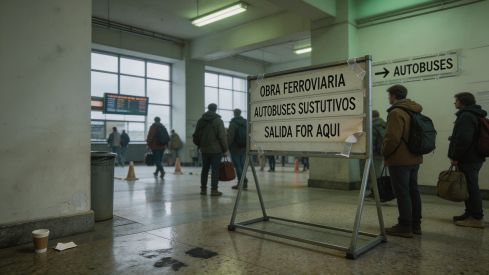
The works in the Garraf Tunnels already alter since this Monday 16 the mobility of users of Regionals of the southern corridor and, at a minimum, will maintain the affectations until mid-June. The arrangement forces travelers on lines R 13, R 14, R 15, R 16 and R 17 to make a combination of train, bus and again train to reach Barcelona.
In parallel, users of the R 2 South of Rodalies have two trains per direction and hour while the works last, since circulation is maintained on a single track between Garraf and Sitges.
First day with incidents and waits at key points
Sant Vicenç de Calders once again concentrates a good part of the device, along with El Prat de Llobregat. There, the "Transport Alternatives Plan" is articulated, designed by the Generalitat with Renfe and Adif, which foresees more than twenty buses between Sant Vicenç de Calders and El Prat de Llobregat, with a journey time of about 45 minutes.
During the first morning of operation, some travelers in Sant Vicenç de Calders had to wait more than an hour without service. Those who were unaware of the disruptions were informed by public address system before arriving at the station.
In Tarragona, the implementation of the plan also drew criticism for the lack of in-person support. At the station, during the morning, there were zero informers beyond the usual staff and a totem in the middle of the lobby with the alternatives.
Close to 80% of the users consulted did know that this Monday the works were starting and that they would have to take a bus to complete the journey to Barcelona.
Resigned users and criticism for the implementation of the plan
Denise Carrasco, a user from Reus, summarized the accumulated discomfort on the part of many passengers.
"With the incidents we have, it no longer comes from here" - Denise Carrasco, user from Reus
Regarding returns from Barcelona, the same user warned of a problem that especially worries those who make daily commutes.
"hours of waiting at the station" - Denise Carrasco, user from Reus
Oscar Ferré opted to maintain his routine with the enabled alternative.
"I prefer to take the train and then the alternative bus, and throughout the week, if anything, I will look at the options" - Oscar Ferré, user
Ferré also explained that he is accustomed to delays of more than thirty minutes and added that with this system he at least trusts in arriving on time.
"In this way I arrive well, because sometimes there are classmates who arrive to class with more than sixty minutes of delay" - Oscar Ferré, user
From user platforms, Ana Gómez Llauradó, spokesperson for Dignitat a les Vies, regretted that the Transport Alternatives Plan had not been deployed earlier at the stations and maintained that travelers arrive at this new phase of works very exhausted and at their limit due to daily incidents and delays.
The same platform assured that the delays on the first day would have occurred because the drivers' schedules had not been adapted in the reprogramming and that adjustments were still being made on Friday. Also on Sunday, forecasts for the Reus service were still being adjusted.
Follow-up on the ground and margin of correction
About sixty people deployed on Monday to carry out an on-site follow-up of the device. Ramsés Garcés, present at the request of the user platforms, conveyed a clear message to the travelers.
"Let people take the bus, not the train" - Ramsés Garcés
On Renfe's part, its spokesperson in Catalonia, Antonio Carmona, assured that if any opportunity for improvement is detected on the ground, it will be done. Along the same lines, Susi López, general director of Transport and Mobility of the Generalitat, admitted that the first day leaves room to correct errors and review those aspects that can be improved even immediately.
An investment of more than three million and a total cost of 6 million
Adif informed days before the start of the works that the direct investment in the Garraf Tunnels exceeds three million. To that figure is added the indirect cost derived from the alternative plan and the reinforcement of interurban services, which amounts to 6 million.
Among those reinforcements is a new direct bus service between Altafulla, Torredembarra and Barcelona. Despite this, that route includes seven stops before arriving at the Catalan capital, which lengthens the journey.
The R 4 recovers the section between Sant Sadurní and Martorell
Coinciding with the works of Garraf, trains have returned to circulate through the section of the R 4 between Sant Sadurní and Martorell, which remained inoperative since the accident in Gelida.
For the moment, through that sector only Regionals trains circulate and they do so on a single track. The current offer is limited to two outbound frequencies in the morning and two return frequencies in the afternoon.