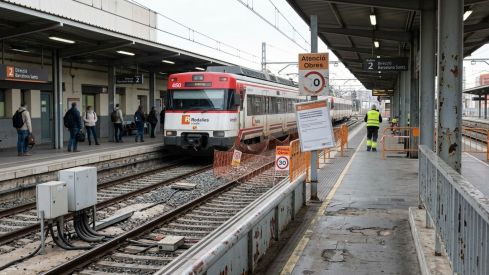
Rodalies train drivers warn that the works to reinforce security on the railway network after the Gelida accident will last for years, according to sector unions, who see it as unfeasible that all necessary actions could be ready in two months.
Pau Mercè, coordinator of the CCOO sector, together with Francisco Cárdenas, from UGT, and Elisabeth Ramos, from CGT, agree that the increase in works and the persistence of speed limitations two months after the accident reflect the poor state of the infrastructure. The union representatives demand more investment, more staff, and more security measures in Rodalies.
The unions question the announced deadlines
The three unions maintain that it was impossible to complete in two months all the actions that the network requires. In their opinion, the current situation demonstrates that the accumulated deterioration goes beyond specific interventions and obliges to maintain in-depth work during a prolonged period.
Mercè assures that the network drags a very significant underfunding over the years and demands staff reinforcements to be able to act before incidents appear. With a reduced staff, only reactive actions can be reached, comes to summarize her diagnosis.
In the same vein, Cárdenas considers insufficient the improvements that are being carried out, while Ramos insists on the need to intervene more quickly and reinforce the maintenance of the conventional infrastructure.
Reduced service and several sections still affected
The Rodalies service remains around 85% of the usual offer, according to data from the operator collected in the information. In addition to the incidents affecting a large part of the network, works in the Garraf tunnels are also added.
Several cut sections with alternative service remain active on lines R3, R4, R7, R8 and R15, in addition to the cut of the southern lines. On the R3, a partial reopening has occurred. Between La Garriga and Ripoll, approximately 50% of services circulate.
The rest of the line remains out of service. Between Barcelona and La Garriga due to the duplication works. From Ripoll northwards because Adif does not authorize it. The partial recovery of the R3 has been put into operation maintaining the bus service.
A deficit of investment that has been dragging on for decades
The forecasts conveyed by the train drivers are close to those of the commissioner for the Integral Transfer of Rodalies of the Government, Pere Macias, who proposes to maintain investment in the network for two decades to compensate for the accumulated disinvestment.
Macias admitted a few weeks ago that more time and more resources are still needed to correct the decapitalization of the conventional network. The investment data handled in the sector point to that gap. The conventional network received 3,600 million euros between 1990 and 2018 compared to the 56,000 million allocated to high speed.
With that scenario, the unions insist that the improvement of the safety and reliability of the service will not be immediate. They propose a sustained response over time, with more budget, more maintenance staff, and structural actions in a network that continues to accumulate incidents and traffic restrictions.