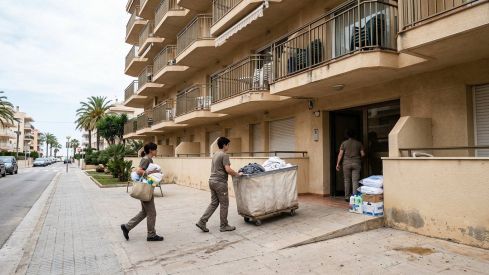
The collective Treballadors pel Lloguer Turístic has requested in Salou the repeal of Decree Law 3/2023 or, at least, an extension that allows the relocation of workers affected by the reduction of tourist apartments planned until 2028. Its president, Guillem Laporta, maintains that the norm puts at risk more than 200,000 direct and indirect jobs in Catalonia and warns of a particularly intense impact on the Costa Daurada.
The entity held its provincial presentation last week in Salou. The movement was constituted six months ago to defend professionals, suppliers, and self-managers linked to short-term rental and has around 2,000 registered members.
"Decree-Law 3/2023 will cause the closure of a large volume of tourist apartments and puts at risk more than 200,000 direct and indirect jobs in the territory; it will be the largest ERE in Catalonia and without the sector even doing badly" - Guillem Laporta, president of Treballadors pel Lloguer Turístic
Salou, one of the points with the most impact
Salou is the second municipality in Catalonia with the most tourist apartments, with 7,163 registered homes, according to data from the Generalitat corresponding to March 2026. Laporta assured that more than 20,000 tourist housing places will disappear in the municipality and that this threatens about 10,000 jobs.
Specifically, the president of the association estimated around 3,500 apartments that would have to be eliminated in Salou if the new framework is applied. He also extended that calculation to the entire province of Tarragona, where he pointed out that there are currently about 23,000 licenses and that most of them would also have to be suppressed.
"We employees are the weakest link in the chain" - Guillem Laporta, president of Treballadors pel Lloguer Turístic
Laporta remarked that the effect would not be limited to owners or managers. It would affect cleaning, maintenance, or check-in and check-out jobs, as well as companies providing services for this type of accommodation, such as those dedicated to noise detectors, booking applications, interior design studios, or laundries.
Regarding this last sector, he warned that there are small businesses whose turnover depends almost entirely on short-stay tourist activity. In some cases, he said, between 80 and 90% of their income comes from this market.
The deployment of the decree reaches until 2028
Decree-Law 3/2023 sets an expiration date for tourist housing licenses and attributes to the city councils the responsibility of deciding which and how many they grant based on their urban planning. The norm also establishes a maximum of 10 tourist housing licenses per 100 inhabitants.
The full deployment of the regulation will culminate in 2028. Laporta warned that, if no changes are introduced, that horizon could translate into mass layoffs. The collective demands that the decree be processed as a bill to be able to incorporate amendments that allow jobs to be maintained.
Support of the mayor of Salou for a differentiated regulation
In the presentation of the collective, the mayor of Salou, Pere Granados, also participated, who reiterated his rejection of a homogeneous application of the decree throughout the territory. The councilman defended that each municipality can regulate this activity according to its specific reality.
"Barcelona and Salou cannot be equated because the problem of access to housing is different" - Pere Granados, mayor of Salou
Granados appealed to the principle of municipal autonomy so that each city council decides how to regulate tourist housing. That approach coincides with the collective's main demand, which claims room to correct the labor impact before the license limitation reaches its definitive phase in 2028.