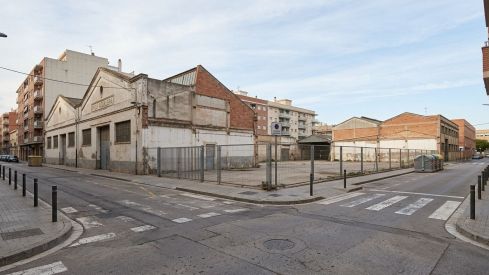
The Reus City Council plans to build 190 public protection homes in the former Pich Aguilera factory, in an urban development action that will go through the ordinary municipal plenary session this Friday. The proposal affects Area 4.85 Pich Aguilera and its surroundings, and proposes to convert all residential floor area that until now was reserved for market-rate housing into affordable housing.
The intervention is part of the municipal strategy to promote the urban regeneration of this sector of the city. The council has designed a modification of the General Urban Planning Plan to reorder the scope of the old silk factory and adapt the planned development to a model focused on public protection.
Change of residential use in the entire foreseen scope
The urban operation foresees that the 190 homes will have protected status, instead of maintaining the residential buildability destined for the free market. The initial approval is foreseen in this Friday's plenary session, a necessary step to activate the transformation of the sector.
For now, the City Council has not specified who would execute the future development. It has not been detailed on the table if the homes would be directly promoted by the council itself, the Generalitat, or a private entity.
Conservation of historic elements of the old factory
The project incorporates heritage conservation criteria within the new planning. The municipal forecast involves maintaining part of the structure of the old textile factory, as well as preserving the building currently used by IES Baix Camp and which has a facade on Jacint Barrau street.
The planning also maintains the interior passage foreseen in the block delimited by Jacint Barrau, Vapor Nou streets, Riudoms road and President Companys avenue. The intention is to make residential development compatible with the preservation of elements considered of historical and symbolic value.
The possible mass grave remains outside the residential plot
In the vicinity of the old Pich Aguilera there is also a possible mass grave linked to the Francoist repression, registered in the Democratic Memory Bank. That reference comes from a testimony written in 2001 by Antoni Batlle, who recorded the existence of a possible well between the old Escola del Treball and the factory.
From that documentation, historians Joan Olivella and Cristian Muñoz, together with the architect Miquel Pich i Aguilera, great-grandson of the former owner, have delimited a hypothesis about the location of that well on Jacint Barrau street. The Municipal Archive has also identified a second well, also linked to the old silk factory, at the foot of the same street.
Memòria Democràtica foresees a ground-penetrating radar (GPR) survey to technically verify this scenario. The available information places, in any case, the possible locations of those wells outside the plot planned for the housing development, so that the residential development and the future patrimonial verification proceed, for now, in differentiated spaces.