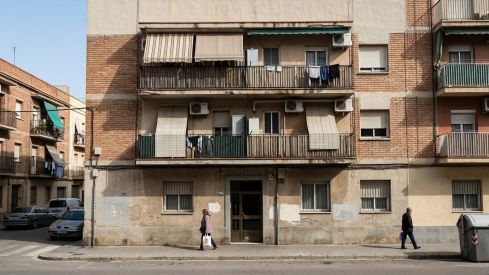
The province of Tarragona lost a total of 1,896 official protection homes in 2025, an exit from the protected stock that especially affects Tarragona city, Reus, Amposta, El Vendrell and Tortosa. The Generalitat's data also reflect that, if there is no intervention, some 5,000 protected homes in the demarcation will have expired by 2030.
The loss of protection concentrated this year in several of the main municipalities of the province. In Tarragona capital, 250 protected homes expired and in Reus, 274. Added to these are 230 in Amposta, 242 in El Vendrell and 170 in Tortosa.
A spacious park, but with protection limited in time
In the province of Tarragona there are almost 13,000 properties with VPO classification. Of that total, 1,827 homes, around 14%, have permanent status and cannot lose their protection. The rest are exposed to disqualification when the term set at the time expires.
The official protection homes built after 2019 already maintain the protection category indefinitely. The 50,000 protected homes announced by the president of the Generalitat, Salvador Illa, at the beginning of the mandate will also have that condition.
The Generalitat activates an extension in stressed areas
The recent modification of the housing law approved by the Generalitat allows to temporarily curb the loss of official protection flats in the municipalities declared as stressed areas. The measure, promoted by the Departament de Territori, Habitatge i Transició Ecològica, extends the initial protection until March 2027 and links it precisely to the existence of those areas with a stressed residential market.
"The extension is one more tool to intervene in the real estate market and curb speculation" - Departament de Territori, Habitatge i Transició Ecològica
The expansion implies that the affected homes can only be sold at an appraised price, must be exclusively for residential use, and cannot be converted into tourist apartments or temporary accommodations.
"The key to the shielding of this measure is its temporality, as it is conditioned on an exceptional situation" - Department of Territory, Housing and Ecological Transition
The same department also defends that there is sufficient jurisprudence to sustain that the right to a decent home prevails over speculative profit. Along those lines, it assures that Catalonia has for the first time its own and structural housing policy aimed at facilitating reasonable prices.
More than a thousand flats would remain protected
If the extension also extends to 2027, 1,196 flats in the province would remain protected and would not pass to the private market. Between 2026 and 2027, 421 homes in Tarragona capital, 426 in Reus and 366 in Amposta will maintain protection.
Also would remain under that regime 371 homes in El Vendrell, 270 in Tortosa, 211 in Cambrils and 185 in La Ràpita.
Legal debate and criticisms of the sector
The extension was incorporated into the legal modification after the Consell de Garanties Estatutàries expressed doubts about the chosen formula, considering that it could violate the principle of legal certainty. That objection has fueled the debate among jurists, developers, and entities linked to the right to housing.
"It is a change in the rules of the game that affects legal certainty and the right to property" - Héctor Simón, UNESCO Chair of Housing of the URV
Simón considers that it is an interference that affects the faculty of enjoyment, even if temporary, because the homes were acquired under conditions that now change. At the same time, he recalls the origin of the problem and places the focus on the lack of historical foresight after the disqualification of this residential park.
"It was a mistake not to foresee what would happen after that disqualification" - Héctor Simón, Càtedra UNESCO d"Habitatge de la URV
The director of the UNESCO Chair of Housing of the URV recalls that between the years 60 and 2010 more than six million public housing units were built in Spain, a model that allowed a notable increase in access to property. In his opinion, now a mechanism must be sought that reconciles the interests of the administration and of the owners to prevent the available stock from continuing to decrease.
From the developer sector, Daniel Roig, president of the territorial commission of the Associació de Promotors de Catalunya in Tarragona, questions the effectiveness of the measure and defines it as a policy more of image than of substance. In his view, the expiration of these homes does not bear a direct relationship with the housing access problem that is intended to be solved.
"Neither the supply nor the prices will be affected" - Daniel Roig, APCE in Tarragona
Roig maintains that these are apartments already occupied by owner families and that their exit from protection does not in itself mean less supply in the market. He also criticizes that the extension alters conditions assumed decades ago by buyers who acquired those properties under another regulatory framework.
Social entities ask to preserve the existing park
In the face of those criticisms, other voices highlight the value of preserving the already built park. Ferran Font, director of studies at Pisos.com, warns that when a dwelling passes to the free market it ceases to fulfill its social function and afterwards it is very difficult to reverse that loss. He adds furthermore that compensating for the disappearance of VPO is a slow and costly process, whereas disqualification has immediate effects.
In the same vein, Guillem Domingo, technician of the Observatory of Social and Environmental Rights, considers that many public resources have been invested in these homes and that losing them makes no sense in a context of scarcity of protected housing stock.
"It is a shock plan that allows maintaining the social function of these properties" - Guillem Domingo, Observatori de Drets Socials i Ambientals
Domingo also suggests that, in the case of homes that already lost protection in 2025 and go up for sale, the administration should study their purchase to maintain that classification. In his opinion, it is faster and more profitable to preserve that stock than to build a new one, in a province that already faces the loss of almost four out of ten protected homes before the end of the decade if containment measures are not applied.