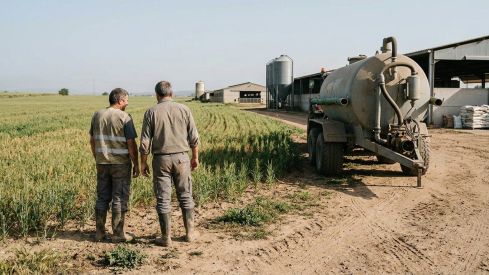
The production of cereals and fodder in Catalonia may suffer a strong setback this very year if the maximum dose of organic nitrogen application from livestock manure is not urgently raised. This is the warning launched by Young Farmers and Ranchers of Catalonia, which demands from the Department of Agriculture an immediate intervention to avoid a direct impact on the field.
The agrarian organization maintains that the increase in the price of urea has placed many farms in a critical situation. The price has gone from 450 euros per tonne to 750 euros as a result of the war in the Middle East and JARC foresees that it may soon exceed 1,000 euros per tonne. In this context, urea can represent between 30% and 40% of the production cost.
The sector warns of an already unbearable cost
JARC considers that urea has become a prohibitive input and, in many cases, directly unavailable in the market. The organization asks that Agriculture defend an increase in the maximum permitted dose of organic nitrogen from livestock manure to compensate for the lack of mineral fertilizers and contain the economic blow on farms.
"These prices are impossible. We cannot feed the country if we are choked by costs derived from distant and unstable markets. We have the solution here: livestock manure" - Vicenç Pascual, head of JARC's cereal sector
Pascual warns that without fertilization production falls and second harvests may be cancelled. JARC adds that the drastic reduction of fertilization doses already entails a direct loss of yield and can lead to a widespread abandonment of second corn harvests.
The Strait of Hormuz aggravates pressure on the field
The Collegiate Veterinary Organization has also warned of the impact of the international crisis on agriculture. The blockade of the Strait of Hormuz due to the Iran war is causing a deficit of nitrogenous fertilizers considered vital for agricultural production. Through this passage transits one third of the world market for nitrogenous fertilizers, which gives a global dimension to the problem that now affects producers.
In this scenario, the entity proposes to accelerate alternatives linked to the utilization of local resources. Among them, developing processes for nutrient recovery from organic waste such as slurries, sludges, and animal by-products, in addition to promoting the production of green hydrogen with renewable energies.
The bet for solutions of proximity
The pressure on fertilizers has reopened the debate on the external dependence of the food system. Both from the agricultural and veterinary fields, there is insistence on reinforcing more resilient and decentralized models, with less exposure to geopolitical crises and more capacity to leverage resources generated within the territory itself. In the midst of the campaign, the sector warns that any delay can translate into less production and more tension over the viability of many farms.