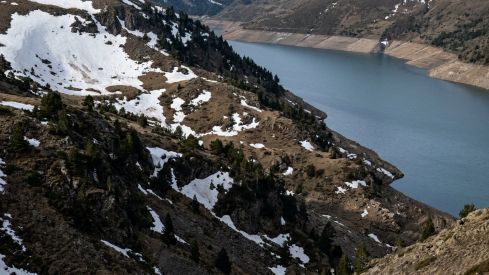
The snow accumulated in the Pyrenees of Lleida has vanished at an alarming rate during the last weeks. The reserves went from 772.2 hm3 to 246.7 hm3 between April 6 and 27 according to official data.
The Ebro Hydrographic Confederation confirms that the total decrease reached 525.5 hm3 in just twenty-one days. This massive reduction is not solely due to the usual snowmelt that feeds the rivers.
The atmosphere devours the snow
A significant part of the snowpack did not turn into liquid water. 149.3 hm3 vanished directly into the atmosphere through the process of sublimation.
This physical phenomenon transformed the ice into vapor without passing through the liquid state due to the intense solar radiation recorded since the end of March. The greatest losses through this route occurred at the headwaters of the Segre.
"Exceeding 50 hm3" - Ebro Hydrographic Confederation
The evaporated volume is equivalent to almost doubling the total capacity of the Oliana reservoir. The figure is striking when compared to the 85 hm3 that this hydraulic infrastructure can store.
Reservoirs far from collapse
Despite the drastic reduction in the snowpack, the reservoirs maintain acceptable levels. The Segre and Pallaresa systems exceed 85 percent water accumulation.
For their part, the reservoirs of the Noguera Ribagorza system reach 75 percent of their capacity. The Canelles reservoir presents a particularly favorable situation.
"The water sheet is 7 meters from the maximum" - Exploitation data
This resistance of the reservoirs contrasts with the speed with which the natural reserve in the peaks disappears. The snow accumulation this winter began two months later than usual.
The peak was recorded in February with more than 2,000 hm3. Now, reserves from April to May are the most meager of the century.
This situation only falls below the extreme drought periods experienced between 2022 and 2024, as well as in 2005-2007 and 2011-2012.
Agricultural demand on the rise
Studies project a future scenario where water availability will decrease while demand grows. A report from Cedex predicts that by 2050, contributions from the basin's river systems will fall by 12.5 percent.
Simultaneously, crops will need more water resources. The first works of the Ebro Hydrological Plan preliminarily quantified an increase of 7 percent in agricultural needs by mid-century.
More recent investigations shoot up these estimates. The University of Castilla-La Mancha raises the increase in water needs of crops up to 13 percent.
Other consultancies like Pigall are even more pessimistic and estimate that increase at 16 percent. The gap between natural supply and human demand widens year after year.
The accelerated sublimation of these last weeks demonstrates that climate change not only reduces precipitation, but also alters the way nature stores and releases water.