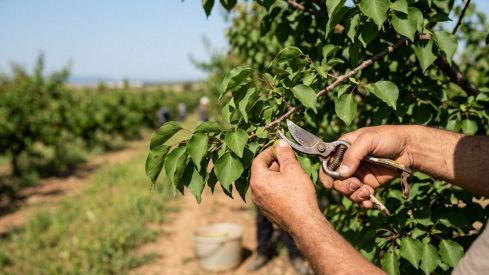
The fruit campaign has already started in Lleida with the harvesting of early varieties of apricot and cherry and with thinning tasks on the farms. At this start of the season, Unió de Pagesos has once again resorted to hiring at origin to cover the lack of qualified labor in the Lleida countryside.
The paradox of the campaign appears at the very beginning of the work. While the farms need experienced personnel for machinery and agricultural tasks, Agroxarxa, the service company of Unió de Pagesos, has hired 2,000 workers from Colombia and 1,200 of them are already in the demarcation to respond to that shortage.
Agroxarxa brings 2,000 workers from Colombia and 1,200 are already in Lleida
One of those farms is in Alcarràs, where nine Colombian seasonal workers are already working in the campaign. There they combine the first seasonal tasks with a hiring formula that the sector has reinforced after the regulatory change approved in 2024.
The current regulation allows offering four-year permanent discontinuous contracts, instead of the annual renewal that was mandatory until then. That change gives more continuity to companies and workers in an activity very dependent on the agricultural calendar.
Jaume Molló, head of the Alcarràs farm, has been applying this model on his farm for four years and highlights two immediate advantages of the system.
"One of the most obvious advantages is the language, and another is that everyone has, to a greater or lesser extent, previous knowledge in agricultural tasks, such as handling tractors, platforms or agricultural machinery, something that ultimately makes the work faster and more efficient" - Jaume Molló, head of the farm, Alcarràs farm
The arrangement also obliges employers to guarantee accommodation and to assume half the cost of the plane ticket. In the case of the Alcarràs farm, the workers reside in municipal accommodation that the farmer has rented for the campaign.
Alcarràs links nine months of agricultural work with temporary return to Colombia
José Joaquín Gutiérrez is part of that group and already has four years of experience in the fruit campaign in Alcarràs. His routine consists of working for nine months in Lleida and then returning temporarily to Colombia.
Gutiérrez explains that the decision to repeat the campaign responds to the economic situation in his country. The continuity of employment in the same area allows some of these seasonal workers to link several campaigns with a more stable horizon than that of annual hiring.
Alejandro Cárdenas has also repeated his destination in Alcarràs. In his second year in the campaign, he assures that he sees the town as a quiet place and that he would like to settle there for a while with his family.
Juan Carlos Yela specifies that the National Learning Service of Colombia, SENA, collaborates with Agroxarxa to facilitate the selection and hiring of workers. He adds that the salaries they receive in Spain are higher than those in their country of origin, one of the factors that sustains the arrival of personnel for the campaign.
The regulations also provide for a path of continuity beyond the harvest. Seasonal workers who participate in campaigns for four years can request to remain for an additional two years in the territory if they secure stable employment.