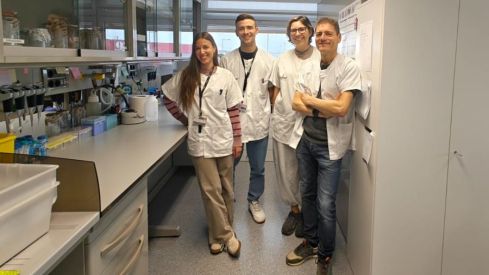
An investigation by the Universitat de Lleida, the IRBLleida, and the IDIBELL has identified an opposite behavior of the miR-424(322)~503 molecule cluster in two types of cancer. The work, published in the journal Cell Death & Disease of the Nature group, concludes that this set of microRNAs acts as a protector against colorectal cancer and, at the same time, favors the progression of endometrial cancer.
The finding places the main contradiction of the study in the molecular mechanism itself. The same molecules that function as oncogenes and favor tumor growth in the female endometrium act as a brake on the appearance of tumor lesions in the colon, so that their absence is associated with more complex and larger precancerous lesions.
The study detected that the loss of the cluster triggers lesions in the colon
Researchers observed that, in models without the miRNA cluster or the PTEN gene, 90% of mice developed some type of tumor lesion in the colon. Within that group, 50% presented low-grade adenomas, 20% high-grade adenomas, and another 20% intraepithelial adenocarcinomas.
Maria Vidal Sabanés, first author of the study and researcher at the Universitat de Lleida and IRBLleida, described the combined effect of both genetic losses on tumor progression.
"The double loss of PTEN and the miRNA cluster generates an environment that allows malignant transformation in the colon, accelerating the rapid progression from polyps to invasive adenocarcinomas" - Maria Vidal Sabanés, researcher at the Universitat de Lleida and IRBLleida
The work thus points to a containment function in colorectal tissue. When this cluster is missing, the colon loses an element that limited the evolution of lesions, and more advanced forms appear within the tumor process.
Xavi Dolcet identified the PTEN gene as the key to the protective effect
The role of the PTEN gene appears as another of the study's main points. Xavi Dolcet, professor at the Universitat de Lleida and head of the Oncogenic Signaling and Development group, explained that the cluster maintains a defensive function when PTEN disappears in the colon.
"When PTEN is lost in the colon, the cluster functions as a protective mechanism that helps to curb the excessive activation of other potentially oncogenic pathways that go out of control without this gene" - Xavi Dolcet, professor at the Universitat de Lleida and head of the Oncogenic Signaling and Development group
In contrast, in the endometrium the behavior is the opposite. There these microRNAs act as oncogenes and promote cancer growth, a difference that forces us to interpret their role based on the affected tissue and not as a uniform target for all tumors.
The research concludes that this molecular duality forces treatments to be guided according to the affected organ. The work has been signed by teams from the Universitat de Lleida, IRBLleida, and IDIBELL and has been published in Cell Death & Disease.