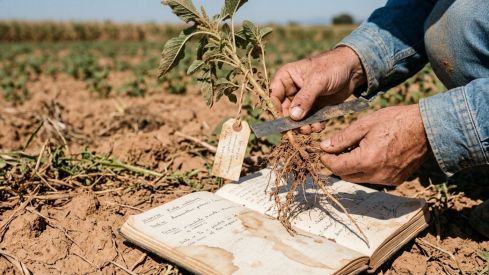
The research group in malherbology and plant ecology led by Jordi Recasens has received the Premi Ciutat de Lleida after forty years of trajectory linked to the Universitat de Lleida campus and the agricultural sector of Ponent.
The recognition comes at a time when the research that has helped contain losses of up to 35% in corn or cereal crops coexists with a paradox within the university itself. Several doctors from the group have not stabilized their positions until the ages of 49, 47, and 45, after depending for years on projects and agreements.
Recasens started in 1980 and the group consolidated its link with companies and cooperatives
Jordi Recasens began his doctorate at the Universitat de Lleida in 1980 and started his research work in 1983, when he collaborated with a technician from the plant health service of the agricultural sector. The official classification of research groups by the Generalitat de Catalunya did not arrive until approximately 25 or 30 years ago.
Over time, the team has signed agreements with multiple companies and cooperatives to advise on crop management. This relationship has been consolidated to the point where many entities now go directly to the researchers.
In parallel, funding for research has grown due to the increase in calls from the Generalitat de Catalunya and the Ministry of Education, many of them aimed at transferring knowledge to private entities.
Even so, job insecurity has marked the group's trajectory. Some doctors managed to stabilize their positions at advanced ages, despite developing their work for years with funding linked to projects and agreements.
The group warns that the abuse of herbicides increases resistance in the field
The awarded team works on a problem with a strong economic impact. The annual consumption of herbicides amounts to 450 million euros in Spain, 15 billion in Europe, and nearly 70 billion worldwide.
Recasens summarizes the risk of always repeating the same chemical strategy with a direct comparison.
"If you apply certain doses of herbicide every year, the same thing happens as if a person always takes an antibiotic, which can generate resistance" - Jordi Recasens, head of the malherbology and plant ecology research group, Universitat de Lleida
The excessive use of herbicides causes genetic mutations in plants that are passed on to offspring and increase resistance. That is why integrated management recommends alternating products with crop rotation and mechanical methods, such as fallow tillage.
One of the cases that causes the most concern is that of amaranthus palmeri, which arrived in Lleida and Aragón eight or ten years ago through feed grain and already carried resistant genes. The species, native to the United States, grows up to two centimeters a day.
Each female plant produces between 500,000 and 800,000 seeds. This expansion capacity forces the testing of different active ingredients and herbicide mixtures to curb its advance.
On that point, Recasens rules out permanent solutions.
"We have found some mixture that may be useful, but if we say it is the solution, we will soon have a resistance problem again, because as it reproduces with so many seeds, some plant will easily mutate" - Jordi Recasens, head of the research group on malherbology and plant ecology, Universitat de Lleida
Glyphosate remains key in more than 60% of no-till farming in Segarra, l'Urgell, and la Noguera
The group has also intervened in the debate on glyphosate, a substance that Recasens considers useful in non-organic production of fruit trees and vineyards and also in no-till winter cereal farming.
In the Ponent regions, its agronomic importance is high. No-till cereal farming exceeds 60% of the cultivated area in Segarra, l'Urgell, and la Noguera, areas where glyphosate is fundamental.
Recasens defends its use with caution.
"I'm not saying it's a panacea, but it's a useful tool that must be known how to use" - Jordi Recasens, head of the research group on malherbology and plant ecology, Universitat de Lleida
The European Weed Research Society participated in the European Union's debate on this matter and warned of the impact a ban would have on numerous producers. Recasens maintains that this was also the dominant sentiment in research centers.
At the same time, the researcher recalls that, although no toxic effects on humans have been proven, glyphosate eliminates vegetation and also insects and other organisms associated with that ecosystem.