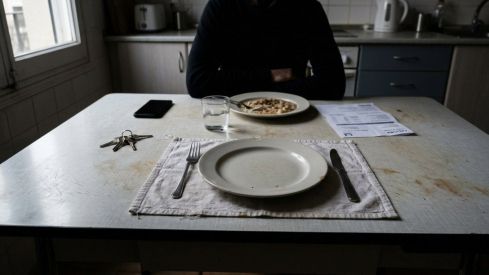
Living alone is already the most frequent type of household in the demarcation, with 51,323 units, but this leadership coexists with another reality that pulls in the opposite direction. Lack of resources forces thousands of people to share housing even if they do not form their own family unit.
Therein lies the main contradiction of the data. Single-person households have doubled since 2001 and tripled since 1991, but they would exceed 60,000 if 5,600 elderly people living in nursing homes and 9,720 adults sharing a home due to the high cost of housing and job insecurity were not excluded.
Single-person households now total 51,323 in the demarcation
The change is also evident in the average household size, which has fallen by 20% in three decades. In 1991 there were 3.14 members per household and now the average is 2.5.
This decrease aligns with other demographic indicators. The birth rate is 1.05 children per woman, and Idescat data from 2021 records more than 25,000 single-parent households, three-quarters of which are headed by women, as well as nearly 30,000 childless couples.
Joan Ganau, a geography professor at the UdL, places the increase in people living alone within a broader transformation of the social and demographic structure. This evolution includes young people trying to become independent, adults living alone, and a growing weight of widowhood.
"Single-person households are basically formed by young people, or not so young, who live alone, and by widows, who are eight out of every nine people with that marital status." - Joan Ganau, geography professor, UdL
Household composition also reflects the delay in leaving the parental home. Ganau specifies that two-thirds of those under 34 live with their parents, a figure that limits the growth of single-person households among the young population.
Lack of affordable housing prevents thousands of young people from moving out on their own
However, the growth continues at a rate of more than 1,200 single-person households per year. This increase is driven by both the emancipation of minors and the rise in widowhood.
In parallel, pressure from the housing market is pushing students and young workers to share flats. This arrangement reduces expenses but also hides part of the real demand for single-person households, as it groups adults who would live alone if they had sufficient income.
Ganau underlines that this difficulty is no longer limited to large cities. The UdL professor maintains that the phenomenon began in large urban centers and has already spread to the rural world.
The evolution of family relationships also accompanies this change. Every year, 1,464 weddings are celebrated, compared to 41 separations and 647 divorces, a figure equivalent to half of the marriages.
One of the most concrete data points of the demographic shift is precisely this economic blockade of emancipation. Joan Ganau, a geography professor at the UdL, summarizes that two-thirds of those under 34 years old still live with their parents.