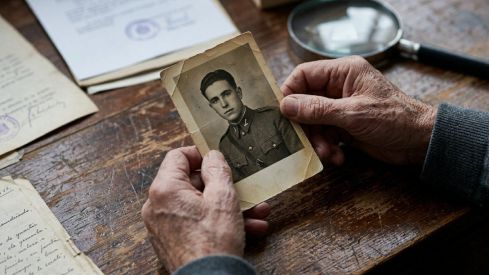
Eduardo Patón Lozano has been listed since May 19 in the census of people who disappeared during the Civil War and Francoism, compiled by the Memorial Democràtic. His documentary trail places his death on January 4, 1939, in a municipality in Lleida, but his family still does not know where he died exactly or where his remains are.
Therein lies the main fracture of the case. The death has been officially recorded for decades, although the death certificate was not registered until 1943 in the Civil Registry of Manzanares, and it was done through witnesses, without specifying the place of death or the location of the burial.
The registration arrived in 1943, but the family never knew where he died
Eduardo Patón was 30 years old when he died. He left Milagros Carretón López a widow and two sons, aged three years and 16 months, in a family that also received no pension or subsidy for disappearance.
José Miguel Camacho Fernández-Medina, Patón's great-grandson, places the beginning of the family's rupture in January 1938, when his great-grandfather was sent to war. The last news they received was a letter informing him of his transfer to the front, and then all contact was lost. The family no longer has those letters.
"My great-grandfather was taken to war in January 1938. I have no record that he left voluntarily; he was surely mobilized, like so many men from inland provinces towards Aragon and Catalonia, and it was a decisive moment to stop the rebel army that was advancing after the Battle of Teruel" - José Miguel Camacho Fernández-Medina, great-grandson of Eduardo Patón Lozano
The inclusion of his data in the Human Cost of the Civil War fund adds formal recognition to that disappearance. For the family, this step allows Eduardo Patón to be identified as a victim and opens a path to try to reconstruct a journey that, for now, remains full of gaps.
Patrimonio Nacional points to Cuelgamuros among the hypotheses about the remains
In parallel, the descendants have begun the process of submitting DNA samples with the intention of locating the remains and burying them alongside those of Milagros Carretón López. The search has also included consultations with military and historical archives, historical memory centers, and civil registries, in addition to the use of artificial intelligence tools, without positive results to date.
Patrimonio Nacional has presented the family with a concrete possibility. The remains could be buried in Cuelgamuros, as approximately 1,400 deceased individuals were exhumed and transferred to the mausoleum from various locations in Lleida.
José Miguel Camacho Fernández-Medina values the historical memory laws because they facilitate these types of searches, although he maintains that reparations remain insufficient if the State does not acknowledge the injustice suffered by the victims. In the same vein, he links family research with a pedagogical task on the human consequences of the war.
"These stories of people who lost their lives and families destroyed by the war should be mandatory teaching in primary and secondary schools within the framework of the culture and protection of democracy and peace" - José Miguel Camacho Fernández-Medina, great-grandson of Eduardo Patón Lozano
The data that supports the entire search today is precise and limited at the same time. The historian Antonio Bermúdez García has compiled that Eduardo Patón Lozano died on January 4, 1939, in a municipality in Lleida.