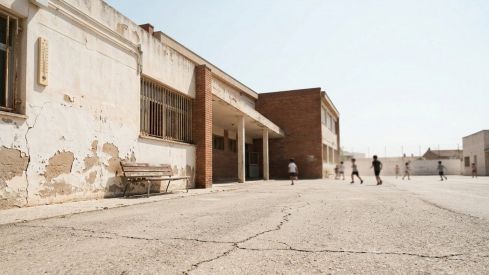
Half of the educational centers in Lleida and in Catalonia as a whole are not adapted to high temperatures, according to a study by the Equitat foundation carried out with researchers from the Open University of Catalonia and the Catalan Institute for Energy Research. The report places the Lleida regions as the most exposed point and calculates that by 2030 one in four school days will exceed 26.7% degrees of comfort in classrooms.
The paradox is that this diagnosis coincides with the signing, yesterday, of an agreement between the Generalitat de Catalunya, the Catalan Association of Municipalities, and the Federation of Municipalities of Catalonia to reform public centers with 100 million euros, a figure much lower than the between 500 and 1,300 million that the study considers necessary to adapt the educational network climatically in ten years.
Lleida will concentrate five of the seven most affected regions
The study identifies Lleida as the area with the greatest exposure to heat in schools. Five of the seven most critical regions in Catalonia due to high temperatures are in the demarcation, with Segrià, Pla d'Urgell, Urgell, Solsonès, and Pallars Jussà among the areas at highest risk.
Mar Satorras, author of the study, maintains that the territorial priority is clear.
"One of the priorities of this country pact would be Lleida without any doubt" - Mar Satorras, author of the study, Equitat foundation
The researcher also points out that in recent years there have been improvements in air conditioning, but she defends reviewing the specific needs of each facility. The report precisely proposes an agreement between the Generalitat de Catalunya, provincial councils, supramunicipal entities, and city councils to adapt the centers within a ten-year period.
The plan proposes two phases and calculates up to 2,000 euros per student
The first intervention proposed by the study involves immediate measures in buildings and courtyards. It includes ceiling fans, reinforcement of night and morning ventilation, natural shading systems, water features in courtyards, and a climate-controlled area in each educational center.
Then, on a five- or ten-year horizon, the document proposes a more profound adaptation of the properties. This includes the comprehensive improvement of buildings, the renovation of courtyards with more vegetation and shade, and the promotion of climate education, with an estimated cost of 2,000 euros per student.
Mar Satorras summarizes that approach in the need to adjust the response to each specific case.
"In recent years, important advances have been made to improve the air conditioning of the centers, but what each one needs should be reviewed" - Mar Satorras, author of the study, Equitat foundation
The Government estimates 100 million for the reform of public centers
Yesterday, in parallel to that diagnosis, the Generalitat de Catalunya, the Associació Catalana de Municipis and the Federació de Municipis de Catalunya signed an agreement to reform and improve public educational centers with an investment of 100 million euros.
Salvador Illa, president of the Generalitat of Catalonia, stated that the agreement can benefit 723 municipalities and maintained that the centers have been neglected "for too long". Esther Niubó, Minister of Education, added that 26.5% of the centers' buildings are from before 1960.
Niubó confirmed that 26.5% of school buildings are older than 1960, a figure that the Government links to the need to modernize facilities and adapt them to new uses and climatic conditions.