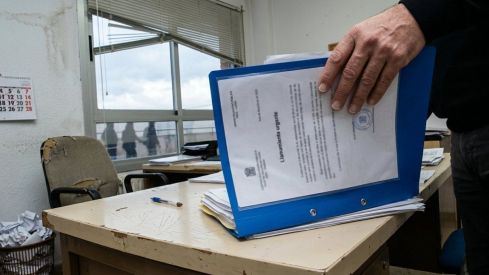
Directors of Primary and Secondary schools in Lleida and the rest of Catalonia have sent a letter to the President of the Generalitat de Catalunya, Salvador Illa, and the Minister of Education, Esther Niubó, to demand significant changes in the education system. The document asks for school leadership to have a central role in decision-making and proposes a review of funding, inclusion, staffing, infrastructure, and working conditions.
The main friction that the signatories convey is the gap between the obligations set by law and the current situation. They recall that the Catalan Education Law of 2009 obliged to allocate 6% of GDP to the sector, a commitment that, they maintain, is not being met while schools assume more functions and more needs with resources they consider insufficient.
Directors demand that the 6% of GDP be met and that model changes be stopped
The letter, titled Urgent Call from the Leadership of Educational Centers in Catalonia in the Face of the Education System's Emergency, calls for a stable and long-term national pact. The leadership asks to avoid continuous changes in models and priorities depending on the political party in power.
In this context, the signatories argue that education professionals should lead this agreement and that leadership should participate actively. Their argument is that they are the ones who know the daily reality of the schools firsthand and the needs that exist both in Lleida and throughout Catalonia.
The demands are organized into six axes. They include the review of the inclusive school decree and the reception model, school autonomy and staff management, working conditions and legal security for directors, educational quality, infrastructure, and the dignification of public education.
The letter asks for more support in inclusion and rejects bringing Mossos d'Esquadra to high schools
One of the most concrete sections affects inclusive education. The leadership proposes to evaluate whether the current deployment guarantees real learning or if the lack of resources prevents its application in classrooms under the planned conditions.
In addition, they demand more resources for students with special needs. They also ask to expand detection in the zero to three years stage, increase support units in Early Childhood and Primary education, and structurally provide technicians and social educators in the centers.
In that same section, the signatories reject the plan to incorporate Mossos d'Esquadra officers into high schools. Their proposal involves reinforcing educational and support resources before introducing a police presence in the centers.
School leadership demands coverage of absences from the first day and the creation of a center manager position
Another part of the document focuses on internal organization. School leadership demands immediate coverage of absences from the first day, advance planning of staffing, and full provision of professionals when new groups are opened.
Along with this, they request institutional and financial recognition for the members of the management teams. They also demand clear regulation of their working hours, their vacations, and homogeneous criteria on teaching rights and duties throughout Catalonia.
The letter adds an administrative request. Directors want the administration to create the figure of a center manager to assume hiring and tendering tasks that currently fall on the leadership.
The letter includes proficiency tests, air conditioning, and the end of temporary classrooms
In the academic field, school leadership urges the recovery of proficiency tests for sixth grade of Primary and fourth grade of ESO in all centers. They also ask for internal evaluation tools and an update of teacher training.
Infrastructure occupies another of the highlighted sections. The text calls for comprehensive and efficient air conditioning in buildings, the replacement of temporary classrooms with permanent facilities, and the renovation of centers deteriorated by lack of maintenance.
To conclude their demands, the signatories ask for measures to dignify public education through greater educational co-responsibility of families and the promotion of post-compulsory studies.