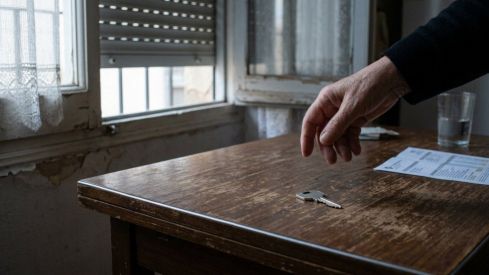
Living alone is already the most frequent type of household in Lleida. The province has 51,323 single-person households, according to the INE, a figure that doubles the 27,519 in 2001 and triples the 15,825 in 1991.
The data coexists with a paradox. Although single-person households are already a relative majority, their actual number would be even higher if about 5,600 elderly people had not moved into nursing homes and if 9,720 adults did not share flats due to a lack of resources to live on their own.
Single-person households would exceed 60,000 without the constraint of lack of resources
With these two factors corrected, Lleida would exceed 60,000 single-person households out of a total of 180,792 homes. Joan Ganau, a geography professor at the UdL, places this change within a broader social and demographic transformation.
"This trend is part of other social and demographic trends" - Joan Ganau, geography professor, UdL
The average household size has also continuously decreased. Lleida has gone from 3.14 members per household in 1991 to 2.95 in 2001 and 2.5 currently, a decrease that accompanies the increase in people living alone or delaying leaving their family home.
Ganau specifies that single-person households are mainly formed by young people, or not so young, who live alone, and also by widows, who represent eight out of every nine people with that marital status. At the same time, two-thirds of those under 34 still live with their parents.
This dual reality also appears in small households and rent, where the increase in single-person dwellings coexists with the difficulties of accessing independent housing.
Couples without children and single-adult families have already surpassed traditional households
The transformation does not only affect those who live alone. Idescat data from 2021 shows more than 25,000 single-mother and single-father households in Lleida, and three-quarters have a woman as the head of household.
Five years ago, moreover, households formed by couples without children and single adults with children had already surpassed in number the almost 54,000 traditional households. Low birth rates reinforce this shift, with a rate of 1.05 children per woman in Lleida.
In parallel, the evolution of couple relationships also influences the domestic landscape. Each year, 1,464 weddings are celebrated, compared to 41 separations and 647 divorces, a figure equivalent to half of the marriages.
Ganau also identifies sharing a flat out of necessity in non-nuclear households, where several people live together because they cannot afford the cost of rent alone.
The UdL geography professor adds that single-person households are growing in Lleida at a rate of more than 1,200 per year.