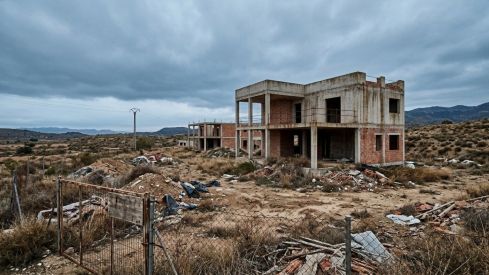
The High Court of Justice of Catalonia has confirmed that a resident of La Pobla de Cérvoles must pay 59,400 euros in fines for building without a license on protected land.
The sentence ratifies the administrative sanction after annulling the demolition orders and reducing the initial amount of 91,400 euros imposed in 2021. The magistrates consider some of the urban planning infractions detected in the Les Foradades area to be time-barred.
Administration replaces demolition with economic sanctions
The Department of Territory modified its original resolution upon verifying that some constructions were not finalized or were underway. Instead of ordering the total demolition, it opted to impose proportional fines on four irregular buildings.
The illegal complex includes a 113-square-meter dwelling, two warehouses totaling 111 square meters, and another auxiliary building of 52 square meters. All these structures were erected in an area classified as a preventive protection open space.
This territorial qualification severely restricts buildability. The Ponent Territorial Plan only allows construction if the work is linked to a real agricultural holding.
The farm does not meet the required agricultural requirements
The regulation requires that the property have ten hectares of cultivation or thirty of forest land for each authorized dwelling. The sanctioned party's plot has a total area of 5.07 hectares, far below the legal minimum.
Furthermore, the owner no longer carries out agricultural activity. This fact eliminates any possible justification for the constructions under the exception of agricultural utility contemplated by law.
"The works predate 2007 and the entry into force of the Territorial Plan of Ponent" - Owner of the property, appellant before the TSJC
The affected party appealed the sanction alleging that the infractions had expired as they were prior to the approval of the territorial plan. However, the court dismissed this argument by maintaining the validity of the basic urban planning regulations.
The judicial resolution leaves open the path of appeal before the Supreme Court. The higher instance could modify the current resolution if it agrees to study the case.