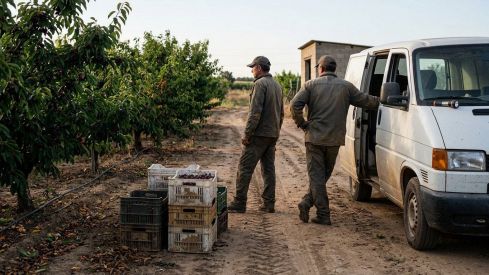
The farmers of Baix Segre have activated a continuous surveillance network to protect their crops in the face of an increase in thefts. Groups of vigilantes with relief shifts cover twenty-four hours a day on the most exposed farms.
The tension in the field has escalated to the point where the producers themselves intercept suspects. Fernando Alcázar recounts how last night he stopped a van and its occupants offered to buy the silver he himself was guarding.
"They asked me how much I sold the kilo of cherries from a farm for, which I covered mid-week" - Fernando Alcázar, farmer
The objective of these gangs is clear and lucrative. The thefts are concentrated exclusively on cherries and apricots, two fruits of high commercial value whose harvest is about to begin.
A quick and very profitable business
The speed of execution turns these thefts into a high-yield crime for thieves. Óscar Moret, general secretary of Uaga in Huesca, calculates that twenty kilos of cherries are harvested in less than half an hour.
That minimum loot represents an immediate income of two hundred euros for the criminals. The black market absorbs this merchandise without questions, integrating it into legal or semi-legal commercial circuits.
Prices fuel criminal interest. The apricot reaches 25 euros per kilo at points of sale, while the cherry usually exceeds 10 euros.
In wholesale distribution, margins remain attractive. The range is between 10 and 12 euros for cherries and between 5 and 6 euros for apricots.
On-demand robberies with a guaranteed buyer
Experts and those affected agree that these are not opportunistic thefts. These are robberies to order, previously agreed upon with buyers of the goods or carried out by the same thieves who act as sellers.
"This is sold in greengrocers and markets or they take it to shops that sell it" - Jaume Gardenyes, Fruit Manager at UP
Traceability is lost as soon as the fruit leaves the farm. Jaume Gardenyes, head of Fruit at UP, demands rigorous inspections at street markets to remove merchandise lacking a delivery note or verifiable origin.
Beyond the economic damage, there is a hidden health risk. Gardenyes warns about the dangers of consuming fruit of clandestine origin that may not have respected the withdrawal periods for phytosanitary products.
Filing systematic complaints is revealed as the only way to force a forceful police response. The Mossos need administrative constancy to justify the deployment of more officers in the area.
Evidentiary difficulty curbs arrests
Capturing these groups is extremely complex for security forces. Sources from the Mossos explain that the key lies in surprising the thieves in the act, as proving the origin of the goods afterwards is almost impossible.
The test is only viable when the loot travels in identifiable boxes or sacks, a common situation in almond or olive thefts but rare in fresh fruit.
The lack of distinctive packaging in cherries and apricots facilitates mixing with legal product. This opacity protects illegal distribution networks and discourages preventive police intervention.
The reality in the countryside shows an unequal duel between citizen vigilance and criminal cunning. While farmers mount night watches, stolen fruit finds a place on the shelves before dawn.