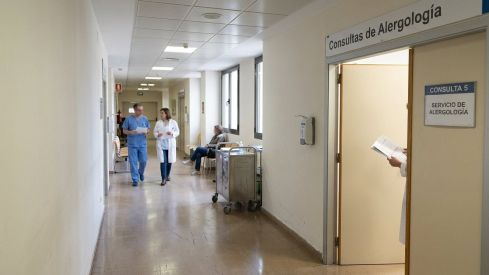
The Santa Maria hospital of Lleida has identified the first cases of a rare disease transmitted by the same sperm donor, in a work carried out together with the Vall d"Hebron Institut de Recerca, the IRBLleida of the UdL and professionals from the Vall d"Hebron hospital of Barcelona. The study describes the first documented case in the world of transmission of hereditary angioedema associated with the F12 gene through an anonymous sperm donor.
The research has allowed detecting three carriers of the same genetic variant, all conceived through assisted reproduction techniques from a single donor. The finding started from the case of a patient treated in the Allergy Service of Santa Maria de Lleida.
The case was detected starting from a patient treated in Lleida
Lluís Marquès, head of the Allergy Service of Santa Maria hospital and researcher of the study, explained that the work started from the case of a young woman who suffered recurrent episodes of swelling of special intensity. In some of them she had to be admitted due to the involvement of the throat and face.
"We didn't know the reason and allergy tests were negative, without the usual treatments yielding results, until we thought of this rare disease, which is triggered when young women take estrogens, such as contraceptives" - Lluís Marquès, head of the Allergy Service of Santa Maria hospital
The genetic analysis identified the T328 variant of the F12 gene, associated with a form of hereditary angioedema mediated by bradykinin. Upon confirming that this variant was not present in the maternal line, the doctors began to suspect that the mutation came from the sperm donor.
The clinic confirmed that the donor was a carrier of the variant
After contacting the fertility clinic, it was confirmed that the donor was a carrier of that genetic variant without knowing it. From there, the researchers located other cases until identifying the three carriers linked to the same origin.
Hereditary angioedema is a rare genetic disease that causes recurrent episodes of swelling in the skin, the digestive system, or the airways. It is a dominant genetic disease, so that a single copy of the affected gene is enough to develop it.
The probability of developing symptoms is very low in men, while in women it can be between 60% and 80%, often conditioned by hormonal factors. That difference was one of the keys that helped guide the diagnosis in the case studied in Lleida.
Serious risk if not diagnosed in time
Marquès warned of the importance of detecting this pathology early because the usual treatments for allergic processes are not effective in these cases. If not diagnosed and the appropriate treatment is not applied, mortality can reach 25% due to swelling of the glottis and the risk of asphyxiation.
The research has been led by Lluís Marquès, Laura Batlle Masó, Eva Alcoceba, Sílvia Lara, Aina Aguiló, Johana Gil Serrano, Mar Guilarte and Roger Colobran, with the participation of professionals from the Santa Maria de Lleida and Vall d"Hebron hospitals, in addition to IRBLleida and VHIR. The work places Lleida and Barcelona at the origin of a description unprecedented until now in the scientific literature on the transmission of this rare disease.