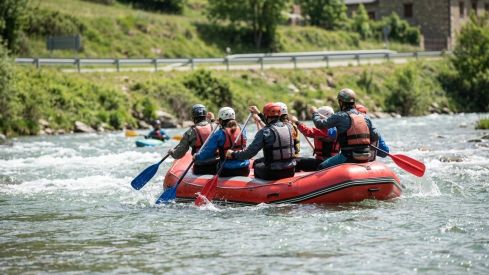
Rafting on the Noguera Pallaresa turns 40 this year since the start of tourist activity on the river, today converted into one of the great engines of active tourism in Pallars Sobirà. Four decades after those first commercial descents, the region has consolidated a model that has ended up marking the development of the sector in the whole of Lleida.
The modern history of this activity dates back to 1986, when Christian Pecquerie arrived in Sort to participate in the launch of the first rafting company on this side of the Pyrenees, driven by several entrepreneurs, among whom was Xavier Gabriel. That firm was later renamed Aventur. Barely five months later, Flòrido Dolcet founded Rubber River, which today is the oldest company in the State that remains active in the specialty of rafting.
A key river for active tourism of the Pyrenees
The Noguera Pallaresa is 146 kilometers long, of which 40 are navigable without interruption, a characteristic that has been decisive in making it a benchmark. Boat descents are carried out from mid-March to mid-October, partly thanks to agreements with Endesa, which regulates the flow upstream of Llavorsí.
"The Pallaresa is the rafting paradise" - Christian Pecquerie
Carles Rabaneda, owner of Roc Roi, also highlights another practical advantage of the route. The existence of a road parallel to the river facilitates the logistics of an activity that depends as much on access as on the mobility of the teams. Rabaneda also emphasizes the importance of the agreement between the Pallars Sobirà Regional Council and Endesa to ensure the flow.
From an incipient activity to a consolidated industry
The beginnings were modest. Flòrido Dolcet recalls that in that initial stage they used to work at Christmas and on weekends, far from the current volume. In 1986, Pallars Sobirà had 5,438 inhabitants. Forty years later, the region reaches 7,332.
"We used to work for Christmas and on weekends" - Flòrido Dolcet, founder of Rubber River
The evolution of the sector has been notable throughout the demarcation. With 2025 figures, active tourism generates 113 million euros in business volume in Lleida as a whole, 37 million more than ten years ago. In the province there are more than 270 companies dedicated to this field and about sixty are concentrated in Pallars Sobirà. Among all of them, they offer 50 activities by land, water, and air and maintain about 1,800 jobs, a stable figure over the last decade.
A region that has served as a model
The establishment of rafting and other adventure activities has made Pallars Sobirà a reference for other territories. Flòrido Dolcet maintains that the region has been the mirror for other destinations and that for years they have taken it as a model. In parallel, the Lleida Pyrenees has reinforced its external projection with other scenarios linked to white-water sports, such as the Segre in La Seu d"Urgell, one of the venues for the 1992 Olympic Games.
"Nature is our DNA" - Juli Alegre, director of the Tourism Board of the Provincial Council
Juli Alegre adds that the great success of the territory lies in its natural environment, an idea that the pioneers of the sector also share. Pecquerie, a resident of Montardit and linked to the project since 1986, points out that the river has changed over the years and that stones have been extracted, which has modified its behavior. In his opinion, before it was not so technical and now it is exceptional.
Between growth and the preservation of the environment
The relationship between the tourism business and the landscape continues to be one of the keys to the debate in the region. Pecquerie explains that he always advocated developing more the sporting aspect of the Noguera Pallaresa, although he admits that something has been lacking in that area. At the same time, he wonders if it is always good to continue growing in a territory that maintains its natural character as its main value.
This year's anniversary arrives with a mature, extended sector and with economic impact throughout Lleida, but with the same axis as in 1986. A unique river, a mountain region and an activity that found in Sort and Llavorsí one of its most stable and recognizable settings.