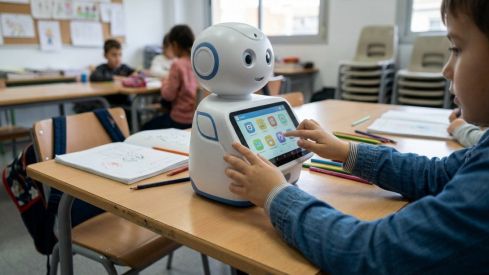
The Robsis project, focused on a social robot to work on the emotions of minors between eight and 16 years old, is already operating in four centers of the Socio-educational Intervention Services of Lleida and in other facilities in Catalonia. The initiative seeks to reinforce the emotional development of young people and prevent situations of school bullying through interaction with a device designed by researchers from the Universitat de Girona and Grup Saltó.
The paradox of the program lies in its starting point. A technological tool enters socio-educational spaces to address problems that are usually detected late in everyday interactions between peers, from the difficulty of naming what one feels to the emergence of behaviors linked to bullying.
The robot Buddy reacts to emotions and proposes three videos
Buddy is the robot developed within Robsis-Robot Social to interact with minors and detect their emotional states. The device incorporates an interface with a face that responds differently depending on what it receives from the user.
"The robot first has an interface with a face that you can interact with and, depending on what it receives, it reacts in one way or another, joy, love, or anger, for example" - Felipe Rodrigo, project researcher
After communicating their emotions to the device, users move on to a second phase in which they watch three videos. This material is designed to encourage reflection and help them express more precisely what is happening to them.
Felipe Rodrigo places one of the main objectives of the project there. The researcher maintains that often different emotions are grouped under a single label and that working with the robot tries to get minors to learn to distinguish them.
"Sometimes we pigeonhole many emotions into one, such as sadness, nostalgia, or loneliness, but they must be felt and interpreted differently, and the robot wants us to know how to differentiate them so that the user improves their emotional development, so they know what they are feeling" - Felipe Rodrigo, project researcher
The SIS centers in Lleida have already tested the system in La Mariola
The tests have already reached four SIS centers in Lleida and other locations in Catalonia. In these initial experiences, the project has registered a good connection with the minors, as well as motivation and learning in a playful format.
One of these trials has been developed at the Centre Obert Calidoscopi, located in La Mariola. There, the mayor of Social Action and Innovation of the Lleida City Council, Carlos Enjuanes, tested the robot.
Enjuanes suggests that the tool can go beyond municipal socio-educational services. In his opinion, it could also fit into the minor's plan in cases of minors who are not criminally responsible, where the legal response has limited scope and social intervention gains importance.
"It is a project that catches our attention and that could be useful not only in SIS, as it could also be applied within the minor's plan for those cases of minors who are not criminally responsible. It would be interesting because legally little can be done, but socially it can be done through projects like this" - Carlos Enjuanes, mayor of Social Action and Innovation, Lleida City Council
Felipe Rodrigo specifies that the initiative is aimed at improving social relationships and avoiding issues such as bullying through the work on empathy and the identification of negative situations. The initial deployment already includes four SIS centers in Lleida and the test at the Centre Obert Calidoscopi in La Mariola.