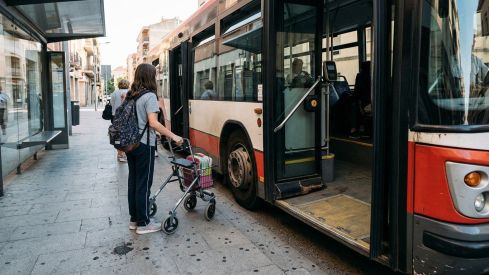
Selene Pérez Zafra, a 16-year-old student from Les Borges Blanques, reports difficulties accessing the Lleida urban bus with her walker on the journey she makes daily between the bus station and the Joan Oró institute, where she studies Baccalaureate.
The young woman, who has cerebral palsy from birth, explains that she uses a walker to get to her Secondary school and maintains that the main problem appears when getting on urban transport within the city. In the interurban service, she assures, the situation is different. "The interurban bus driver helps me", she states.
His/Her complaint focuses on the attention he/she receives on some urban lines. "But to catch the urban bus, it depends on the driver's mood," he/she relates. He/She also assures that in some cases entry is facilitated for him/her and in others not. "I request that they lower the access ramp for me and there are those who do it and who even lower the tire pressure so that I can enter, but there are others who make it very difficult for me."
The student denounces refusals to deploy the ramp
Selene maintains that some drivers have refused to activate that access system. "They refuse to deploy it because they argue it's for wheelchairs. They reproach me, saying if I can't travel alone, why don't I go accompanied?". The student defends that being able to move around Lleida without help is part of her personal autonomy and her academic daily life.
"I can handle the difficulties that arise, but to get on a bus I have to rely on the driver's kindness or on some passenger helping me," she explains. She also specifies that she has a wheelchair, although she manages better with a walker. "But I get around better with a walker, as I can carry my school books and notebooks and my food. I already prepare my routes and time myself so as not to inconvenience anyone."
The student considers the barriers she encounters unfair and points out that the regulations protect access to transport for people who use walkers or crutches. In her opinion, companies must facilitate the deployment of ramps and guarantee their correct functioning. "Because it's not my fault I have this problem," she laments.
A regulation in force since January expressly includes the use of walkers
In October, the plenary of the Paeria approved a new regulation of Lleida's urban transport that updated the one from 2022. That text is in force since January and modifies several articles on the admission of walkers, an element that did not appear expressly in the previous regulation.
The current regulation states that walkers can enter the bus via the ramp, a provision that coincides with the claim that the student raises in her daily commutes.
The family assures that it has not received a response
Selene's family has contacted Moventis, the company that manages Lleida's buses, and also the Paeria, although it assures that for now it has not received a response. The young woman maintains that her situation does not respond to a specific problem, but to a lack of uniform application of accessibility measures.
From the dealership, its manager, Carles Soldevilla, assures that he has not received any complaints about this matter and maintains that access for people with reduced mobility, including those who use walkers, is guaranteed. "If they ask for the ramp to be deployed, they have to lower it", he states. He also indicates that complaints can be filed and that there are no instructions to veto access for people who need walkers to board the bus.
Meanwhile, Selene continues making the same route each day between the station and the institute with the uncertainty of whether she will be able to get on the bus under equal conditions, despite the fact that the municipal regulation already expressly contemplates access with a walker.