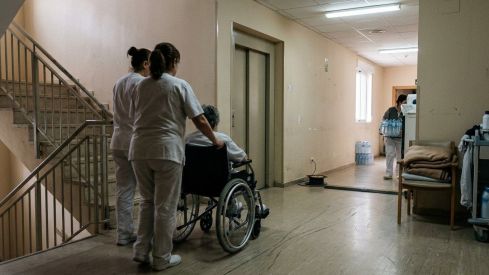
The blackout left an especially complicated situation in the Residència Adesma Sant Antoni de Pàdua, where the lack of supply forced a race against time to reorganize daily care for users and evidenced the absence of emergency resources to respond to an incident of this type.
Rosa Horta, linked to the center, relates that one of the main concerns during those hours was the impossibility of guaranteeing basic tasks if the incident prolonged. "The biggest fear I had was that the blackout would last until the next day because we couldn't prepare meals", she explains.
Problems of communication and mobility in the center
The fall of the supply not only affected the ordinary functioning of the residence. It also complicated internal coordination at a time of maximum need. Horta thus summarizes that feeling of blockage. "It was very uncomfortable not being able to communicate and organize ourselves".
One of the most delicate points was the mobility of people with greater dependency. Without elevators, staff had to resort to manual means to cover movements within the building. "As the elevators were not working, we had to carry people in wheelchairs up the stairs", recalls.
Support from the environment during the most difficult hours
In the midst of difficulties, the residence found support outside of its own resources. Horta highlights the response of workers, neighbors, and local merchants, who collaborated to sustain the basic activity of the center while the incident lasted.
"With off-duty people coming to help, and neighbors and local merchants trusted us with food and water and made vehicles available to us for shopping" - Rosa Horta, Residència Adesma Sant Antoni de Pàdua
That support network allowed to alleviate part of the pressure at a time when the residence had compromised essential services and needed immediate solutions to attend to the residents.
No changes after the incident
Despite what happened, Horta admits that the center still does not have specific tools to respond to a new blackout of these characteristics. "Now we do not have any emergency device for these cases, we have not learned", he laments.
Their testimony puts the focus on the fragility with which some care facilities face prolonged incidents, especially when they affect basic supplies and people with reduced mobility or continuous care needs.