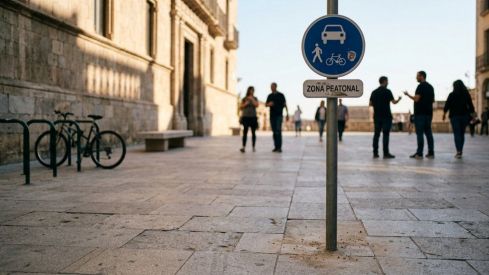
The Girona City Council will limit traffic in Plaça de Catalunya with an access control camera on the east road and will reserve passage for residents and authorized vehicles. The measure comes after the closure of the participatory process initiated by the council to define the future of this central space.
The action changes the function of a square that today remains a transit point for various urban routes, but which the municipal government wants to orient towards travel linked to the neighborhood and authorized uses. The plan also foresees freeing up space, reorganizing exits, and relocating several services in the immediate vicinity.
The camera will limit entry from Carrer del Carme
The access control will be installed on the east road of Plaça de Catalunya, from the intersection with Carrer del Carme, with a similar operation to the entrance to Barri Vell. From that point on, only authorized vehicles will be able to circulate.
These include residents registered in Plaça de Pompeu Fabra, Plaça de Catalunya, Avinguda de Sant Francesc, and Carrer del Carme from Pont de l'Areny onwards. Residents of the Pedreres-Fora Muralla and Torre Gironella influence areas will also have access.
In addition, the council will implement two-way traffic on the south road of the square to facilitate the exit of vehicles coming from Carrer del Carme, Pedreres, or Torre Gironella via Passeig del General Mendoza.
The plan relocates disabled parking, motorcycles, and the taxi stand
The reorganization of the space includes parking for bicycles and cargo bikes next to the Girocleta station, on the north road. This intervention will involve the loss of parking spaces for motorcycles, which the City Council plans to compensate with new spaces in the surrounding area.
The area next to Plaça de Pompeu Fabra will also be freed up. Parking spaces for people with reduced mobility will be moved to another nearby and accessible point, while the municipal government will study moving the taxi stand from Avinguda de Sant Francesc to the west road of Plaça de Catalunya.
On Avinguda de Sant Francesc, the space that becomes free will be used for loading and unloading. All actions will be applied progressively once the technical services validate their feasibility and impact, with alternatives for the uses that the square will no longer assume.
During the presentation of the conclusions at Espai Cívic Mercadal, Lluc Salellas i Vilar, mayor of Girona, defended that the process allows progress in a square designed for people, with measures agreed upon with the neighborhood and entities and with the maintenance of accessibility and daily uses.
Isaac Sànchez Ferrer, councilor for Mobility and Public Space of the Girona City Council, placed the reform within the municipal strategy of urban pacification and renaturalization and recalled that it is part of the 64 points of the 2023-2027 government pact.
42 entities and associations have participated in the participatory process, including neighborhood collectives, mobility and accessibility groups, the University of Girona, the College of Architects, and the Chapter of the Cathedral of Girona.
The square faces this second major intervention while structural reinforcement work is already underway to guarantee its stability and safety.