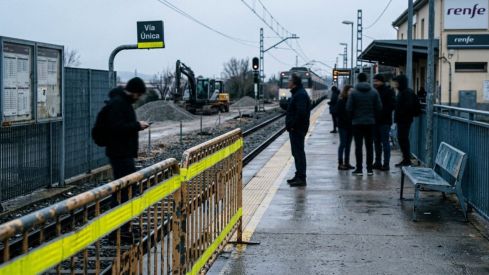
Four months after storm Harry, rail service in the Girona region is still far from returning to normal and maintains service cuts on several lines. The situation directly affects the municipalities on the R11 line and users of the R3 line, where partial rail journeys and alternative road transport still coexist.
The main anomaly is concentrated on the R11. Thirteen stations have gone from having a train every hour to one every hour and a half, a 33% reduction compared to the service that existed before the storm and the Rodalies crisis.
Thirteen R11 stations still have one train every hour and a half
The cut affects Colera, Llançà, Vilajuïga, Vilamalla, Sant Miquel de Fluvià, Camallera, Sant Jordi Desvalls, Bordils-Juià, Celrà, Fornells de la Selva, Riudellots, Hostalric, and Riells i Viabrea-Breda. All of them have lost the frequency of one train per hour that they had before the service alteration.
Renfe maintains that it will not change the schedules for now and that there is no planned date to do so until the problems on the RG1 and R11 lines are resolved. It will be then when the operator re-evaluates the schedules of both lines.
Furthermore, the reduction in journeys on the RG1 is explained by temporary speed restrictions between Maçanet and the south. Renfe argues that, with these restrictions, maintaining the same number of frequencies is neither efficient nor competitive.
Works between Flaçà and Sant Miquel de Fluvià extend the impact until July
To the north, the delays and reduced frequency are linked to the works between Flaçà and Sant Miquel de Fluvià, which began on May 4th. The work requires temporary single-track operation to improve the bridge over the Ter river in Flaçà and to build a new underpass at Sant Miquel de Fluvià station.
Renfe anticipates that the single-track operation between Flaçà and Sant Miquel de Fluvià will end on July 3rd. Until then, the service maintains conditioned operations on this section of the network.
The R3 maintains only half of the service from before January 20th
On the R3 line, rail service only operates between La Garriga and Ribes de Freser. The rest of the corridor coexists with an alternative road service between Fabra i Puig and Puigcerdà.
Right now, the R3 offer is equivalent to 50% of what existed before January 20. Added to this are the speed limitations due to infrastructure improvement works and the increase in maintenance hours, which make journeys last longer than usual.
Renfe maintains July 3 as the next concrete date to resolve the single-track circulation between Flaçà and Sant Miquel de Fluvià, a key section for the recovery of service in the demarcation.