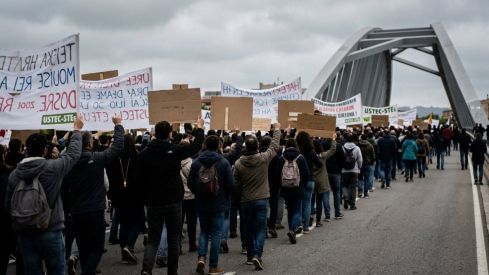
About 2,000 teachers according to police sources and 4,000 according to USTEC-STEs demonstrated this May between the Pont del Dimoni in Girona and the municipal pavilion of Salt in the sixth day of strike by Gerundense teachers. The march started at 9:00 AM and took place hours before the negotiation meeting scheduled for 3:00 PM with the Department of Education.
The protest once again brought to the forefront a paradox that teachers have been repeating for weeks. Although part of the public attention has focused on salary loss, several teachers maintain that the conflict has become entrenched mainly due to staff shortages, class sizes, and resources to support classrooms where a growing portion of students requires specific support.
The protest gathered up to 4,000 people before the meeting with Education
The call came from USTEC-STEs, Professors de Secundària, CGT, and La Intersindical, with the support of the Assemblea de Docents de Girona. The route connected two very specific points in the urban area of Girona and Salt and culminated in another day of pressure before the meeting with the Catalan administration.
Glòria Polls, spokesperson for USTEC-STEs in the Girona regions, defined the mobilization as a "very powerful demonstration of strength" and called on the Government for a "real" negotiation with resources, timelines, and guarantees. Polls also warned that if an agreement is not reached, the conflict could lead to an indefinite strike.
"Inclusivity cannot continue to be an empty discourse because 40.6% of students have recognized specific educational support needs" - Glòria Polls, spokesperson for USTEC-STEs in the Girona regions
The list of demands goes beyond salary. The unions are asking for the recovery of purchasing power, the incorporation of more staff in the classroom, the reduction of class sizes to 15 students in primary and 20 in secondary, the reduction of bureaucracy, the stabilization of staff, and the establishment of clearer and more consensual curricula.
Teachers place attention to diversity ahead of the salary conflict
Olga Samper, a teacher at a high school in Calella, explained that the Department of Education owes her more than 5,000 euros in bonuses that she stopped receiving. Even so, she stressed that this financial claim has overshadowed others that she considers more urgent, such as the impossibility of properly attending to 30 students when more than half have special educational needs.
Núria Fernández, a teacher at a school in Girona, focused on the lack of support within the classroom. Fernández said that schools do not have sufficient resources to respond to neurological, speech, cognitive, or high-ability needs and that this deficiency forces teachers to lower the level because they cannot reach everyone.
The economic pressure of sustaining a prolonged strike also emerged. Josep Maria Tolsà and Natàlia Carricondo, secondary and vocational training teachers from Sils, estimated their accumulated domestic economic loss at around 1,000 euros for having supported all the calls, although they maintain that they do not want to work under these conditions nor have their children receive such an education.
Among the most repeated complaints was the collapse of the reception classrooms. The protesters denounced that with 40 students and only two teachers, it is impossible to teach Catalan under proper conditions, and they stressed that the level of organization of the collective had not reached a similar intensity since the 1980s.
The day ended with a blockade on the AP-7 in Salt without union support
After the demonstration, a group of participants blocked the AP-7 near Salt. The organizing unions distanced themselves from this action, which came after several hours of mobilization on a day marked by pending negotiations with the Departament d'Educació.
Polls summarized the relationship between working conditions and learning with an idea that she repeated during the protest. The USTEC-STEs spokesperson in the Girona regions maintained that the conditions under which teachers work are the same under which students learn.