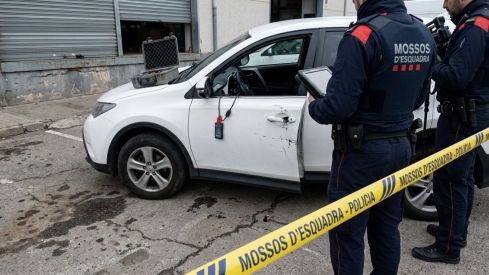
The Supreme Court has confirmed that the investigating court number 2 of Lleida must remain in charge of the investigation into the network dedicated to the massive theft of Toyota RAV4s for export to Gambia and other African countries. The ruling thus closes the jurisdictional dispute opened with a court in Almería.
The decision consolidates in Lleida a case with ramifications in several territories and ports of the State. Although the network operated with bases in Girona, Lleida, Almería, and Huesca, the criminal chamber of the high court endorses that the main core of the police and judicial investigation has been developed in the capital of Segrià.
The Supreme Court endorses Lleida continuing the case as the central point of the investigation
The case began in August 2023, when the Mossos d'Esquadra detected an increase in Toyota RAV4 thefts in Lleida. From that spike, the agents identified about twenty cases in the city and began to reconstruct the network's operation.
A footprint found in a recovered vehicle linked a French citizen to the network. This breakthrough placed a relevant part of the initial proceedings in Lleida and reinforced the role of the court that had taken charge of the investigation.
Furthermore, the Supreme Court recalls that in cases against criminal organizations with operations spread across several territories, the body that is in the best position to continue the investigation effectively must prevail. In this case, the chamber considers that this position corresponds to the court in Lleida.
The network moved stolen cars from several bases to containers destined for Banjul
The investigation is part of two police operations carried out in May 2024 and October 2025. In both actions, Mossos d'Esquadra and Customs Surveillance dismantled the international vehicle smuggling network.
The operation ended with a dozen arrests and the recovery of dozens of cars. The network's logistical structure was supported by bases located in Girona, Lleida, Almería, and Huesca, from where the vehicles were shipped in containers through the ports of Barcelona, Castellón, or Valencia.
The final destination of these shipments was Banjul, as part of an export route to Gambia and other West African countries. In this scheme, investigators identified a Swedish citizen as the coordinator of shipments between Spain and that destination market.
The court of Lleida authorized telephone taps on that suspect, a diligence that also weighed on the discussion about which body should maintain jurisdiction. The case connects with other investigations into car thefts and with the use of logistical routes already detected in ports used for exports.
The agents found 15 cars in four containers ready to leave
In one of the interventions, the agents seized 15 stolen vehicles that were ready for export. Their market value was around 300,000 euros.
The cars appeared inside four containers already prepared for their departure. The network used technology to open the vehicles by simulating the original key and also altered license plates and chassis to make police tracking difficult.
The Supreme Court's ruling leaves the investigation in the investigating court number 2 of Lleida, where key diligences on the plot had already been authorized, including wiretaps on the alleged Swedish coordinator of shipments between Spain and West Africa.